How to Rank in AI Search: Platform by Platform
How to rank in AI search on ChatGPT, Claude, Gemini, Perplexity and Google AI Overviews: where each one retrieves from, and what the measured evidence says.
 Published Last updated 14 minute read
On this page 13 sections
- How do you rank in AI search?
- How is AI SEO different from traditional SEO?
- Why is AI search several channels rather than one?
- Does a Google result still get you into AI search results?
- How to rank in ChatGPT
- How to rank in Claude
- How to rank in Gemini
- How to rank in Perplexity
- What about Grok and Microsoft Copilot?
- How do you rank in an AI Overview and in AI Mode?
- Which AI platform should you work on first?
- How do you measure AI search visibility?
- Choose one buying task and the assistant your evidence supports
Short answer: To rank in AI search, make each page reachable by the crawler every assistant uses, open every section with its answer, and earn mentions on the sites your buyers read. Then measure each platform on its own, because ChatGPT, Claude, Gemini, Perplexity and Google AI Overviews retrieve from different indexes. There is no single AI search ranking, so start with one buying task and a small, repeatable prompt panel.
How do you rank in AI search?
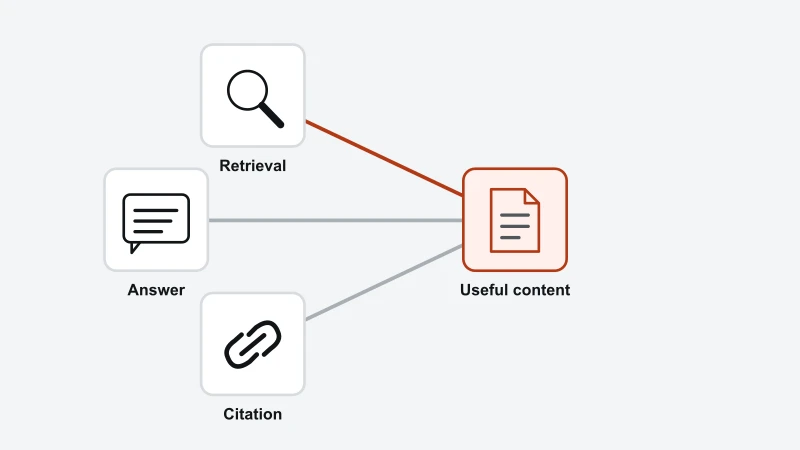
You rank in AI search by being retrieved, then quoted, on each platform separately, because there is no single AI search ranking to win. ChatGPT, Claude, Gemini and Perplexity each decide which pages enter the context their answer is written from. Google AI Overviews makes the same decision on a results page, from Google's own index.
So the same site can be prominent on one platform and absent from another. The work splits in two: a shared floor that helps everywhere, then per-platform effort where your buyers are.
How to optimize content for AI on every platform
Four practices make up that shared floor, and they are the ones worth doing first. Each one makes a page easy for AI to read, retrieve and quote, whichever AI engine is asking.
Server-render every word that must be found
GPTBot, ClaudeBot and PerplexityBot execute no JavaScript, so text added after the page loads does not exist for them.
Structure your content answer first
Retrieval lifts passages rather than whole pages, and clear section openings help AI systems lift the right one.
Keep one canonical brand name everywhere
A consistent name lets an AI system resolve who you are when a passage is read on its own.
Earn presence on third-party sites your buyers read
For commercial questions, editorial reviews and comparison sites are the type of content AI responses often draw on, ahead of a brand's own pages.
The generative engine optimization guide covers the mechanics behind those four, including query fan-out and what happens to a page during grounding. This article covers what differs once you stop treating AI search as one channel. To work through both halves in order, the 30-day AI visibility plan sets out what to do each week.
How is AI SEO different from traditional SEO?
AI SEO, the work of ranking in AI search, differs from traditional SEO in what competes. A traditional search engine ranks pages and returns a list of search results a person chooses from. AI search retrieves passages and returns one answer, so the competing unit is a section and the prize is being quoted rather than clicked.
Question | Traditional SEO | AI search |
|---|---|---|
What competes | Whole pages | Passages within pages |
What the reader gets | A results page of links | One written answer with a few sources |
What the page is scored against | The query as typed | Synthetic sub-queries the system writes |
What the crawler reads | Rendered pages, for Googlebot | Raw HTML only, for GPTBot, ClaudeBot and PerplexityBot |
What success looks like | A position and a click | A citation, a brand mention, or both |
The rows show two mechanical differences. Retrieval scores your content against sub-queries nobody typed, so a page has to answer neighbouring questions too. And because three major crawlers read raw HTML only, server-side rendering is a precondition rather than a performance choice.
Most of traditional SEO carries over unchanged, which the more excitable guides understate. Indexing, crawl access, internal links, clear structure and content worth reading still decide whether a page is retrievable at all. The common own goal is blocking AI crawlers by accident, usually at the CDN, and usually while meaning to block training rather than search.
Google Search Central's guidance for AI features asks for the same foundations as ordinary Search, so SEO and AI search share a floor. To make sure your content qualifies, it names unique content written for people, pages Google can crawl and index, preview controls, and structured data that matches the visible content.
The two worlds meet in Google AI Mode, which answers conversationally from the index that serves ordinary results. The full comparison of the disciplines is in the GEO versus SEO breakdown. What matters here is that traditional SEO is the floor under every assistant, not a replacement for per-platform work.
Why is AI search several channels rather than one?
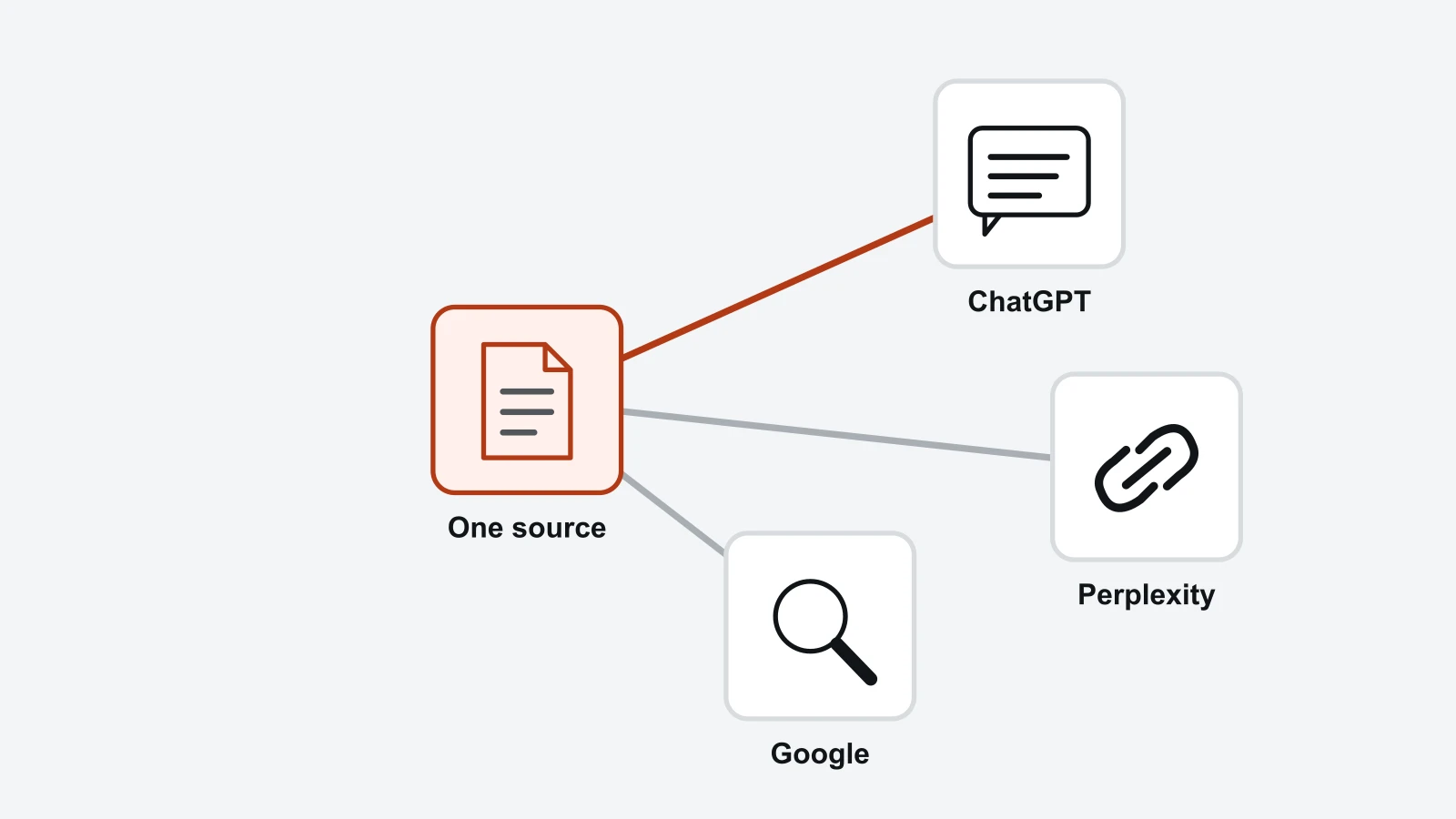
AI search is several channels because the major assistants retrieve from different indexes. A page ChatGPT finds easily may be invisible to Claude, not because it is worse, but because Claude queries Brave's index and ChatGPT queries its own. Content strategies built for one assistant rarely transfer whole, and assuming the rest follow is the most expensive mistake in this field.
- Assistant
Record which system answered.
- Prompt
Keep the actual question and context.
- Outcome
Store mentions and sources for that answer.
Surface-specific evidence makes a combined report interpretable.
Assistant | Retrieves from | How much Google SEO transfers |
|---|---|---|
ChatGPT | Its own index, crawled by OAI-SearchBot, plus licensed data | Partly. Bing alignment collapsed during 2025 |
Claude | Brave Search, plus Anthropic's own Claude-SearchBot index | Least on this list. Brave's index is not Google's |
Gemini | Google's index and rendering infrastructure | Most of it. This is Google Search underneath |
Perplexity | Its own index, rebuilt in-house during 2025 | Partly. Google rank correlates but is not the mechanism |
Grok | The open web and the live X post graph, in parallel | Partly, alongside a social graph Google does not see |
Microsoft Copilot | Bing's index, through Microsoft's grounding | Partly. Bing runs its own index, so Bing coverage is checked separately |
The overlap between those channels is small, and it has been measured. Profound ran 100,000 identical prompts through ChatGPT and Perplexity and found only 11 per cent of cited domains appeared on both.
Ahrefs tested ChatGPT, Gemini, Copilot and Perplexity across 15,000 long-tail queries. The share of AI-cited URLs that also rank in Google's top 10 ranged from 6.1 per cent to 28.6 per cent depending on the platform, averaging 11.9 per cent.
Does a Google result still get you into AI search results?
A strong organic search result still helps, but much less than the figure most guides quote, and that figure is now two studies out of date. The number circulating on this SERP is that 76 per cent of the pages cited in AI Overviews come from pages ranking in the top 10. Ahrefs published it in 2025, then replaced it with a larger follow-up, and the correction changes what a site should work on.
Study | What it counted | Figure |
|---|---|---|
Ahrefs, 1.9 million AI Overview citations | Share of cited URLs that also rank in the top 10 | 76 per cent |
Ahrefs, 863,000 SERPs and 4 million URLs, March 2026 | The same measure, on more than double the sample, counting blue links only | 37.1 per cent |
SEranking, 18,767 keywords, November 2024 | AI Overviews containing at least one top-10 domain | 92.36 per cent |
In the March 2026 test, pages ranked 11 to 100 supplied 26.2 per cent of AI Overview citations and pages outside the top 100 supplied 36.7 per cent. A second Ahrefs test counted every SERP block rather than blue links only, which puts the top 10 at 37.9 per cent, positions 11 to 100 at 31.2 and beyond 100 at 31.0. Ahrefs headlines the pair as 38 per cent, so quote three numbers from one test or the other, never one from each.
The likeliest driver of the fall is that Gemini 3 became the default model behind AI Overviews in January 2026. It fans queries out more aggressively, drawing on a wider pool of sources per answer.
Why 37 per cent and 92 per cent are both true
Those two figures look contradictory and are not, because they count different things. SEranking asked how many AI Overviews contain at least one top-10 domain, and got 92.36 per cent. Ahrefs asked what share of all cited URLs come from top-10 pages, and got 37.1 per cent.
An answer citing eight sources, one of which ranks third, satisfies both at once. Ranking in the top 10 search engine results gets a site into the candidate pool. The result is that most of the other seats go to pages that do not rank there.
Chasing position 3 to win one citation slot, while ignoring the sub-questions that fill the other seven, is the strategy those two figures rule out together. One caution on freshness: the SEranking research is from November 2024 and predates Gemini 3, so treat 92.36 per cent as the direction rather than today's dose.
Why do so many guides still quote 76 per cent?
Guides still quote 76 per cent because the page carrying that figure was never corrected. Ahrefs' own guide to ranking in AI Overviews, published on 20 January 2026, states that 76 per cent of cited pages rank in the top 10 with a median position of 2. That guide ranked third for this query at the time of writing.
Ahrefs published the 37.1 per cent correction roughly two months later, on a sample more than twice the size, as a separate article. Nobody is being dishonest: a research update and an evergreen how-to are different pages with different review cycles.
Two things follow. A page that ranks 40th for its head term is a realistic citation candidate now, which changes the economics of pages a team had written off. And a guide quoting 76 per cent in 2026 is repeating a number its own publisher replaced.
How to rank in ChatGPT
Ranking in ChatGPT starts with letting the right crawler in, because ChatGPT retrieves from an index OpenAI builds itself. OAI-SearchBot is the bot that populates ChatGPT Search, GPTBot is the training crawler, and ChatGPT-User handles fetches a person triggers. Blocking GPTBot does not remove a site from ChatGPT Search; blocking OAI-SearchBot does.
ChatGPT's retrieval channel decides almost everything, so a page reaching that index matters more than any social presence. The four crawlers, the citation rates by source type and the August 2026 collapse in social citations are in the full guide to ranking in ChatGPT.
ChatGPT answers product questions from a second surface too. ChatGPT Shopping returns a carousel of product cards built from a merchant feed submitted to OpenAI rather than from the search index, with its own required fields. Merchants need the ChatGPT product feed as well as everything above.
How to rank in Claude
Ranking in Claude means ranking in Brave Search, which is what makes Claude different from the other assistants. Anthropic's published subprocessor list names Brave Search as the web search provider for all of its products. A Bing or Google playbook does not carry over, because Brave runs its own independent index.
Anthropic also runs Claude-SearchBot, which indexes pages to improve Claude's search results, and Claude-User for fetches a person triggers. Both are controlled separately from ClaudeBot, the training crawler. A site that blocked ClaudeBot to opt out of training is still eligible for Claude's answers, and a site that blocked all three is not.
Claude has the least published research behind it of the major assistants. No large-sample citation study of Claude exists at the time of writing, so the defensible actions are the documented ones: confirm Claude-SearchBot and Claude-User receive 200 responses in your server logs, and check whether Brave Search returns your pages for the questions you care about.
From RankX AIMeasure the questions that matter to your store.Use one useful category, product or guide as the intended owner of each distinct task.Explore AI visibility trackingHow to rank in Gemini
Ranking in Gemini is the closest thing to ordinary Google SEO on this list, because Gemini rides Google's index and rendering infrastructure. Gemini inherits Googlebot's rendering, so JavaScript-built content can reach it. That is not a reason to relax server-side rendering, because the crawlers behind ChatGPT, Claude and Perplexity still read raw HTML only.
Google-Extended is the control that matters, and it is widely misread. It decides whether Google may use your content to train Gemini models and to ground Gemini apps; Google states it does not affect inclusion or ranking in Google Search. AI Overviews answer to indexing, snippet controls and Search Console's Search generative AI setting.
A restrictive max-snippet directive caps what Google's AI answers may quote, which makes it a self-inflicted visibility limit. The Gemini SEO guide works through which robots.txt token controls which Google surface, and what each one costs.
Gemini is also where brand naming behaves opposite to ChatGPT. In the Semrush data, Gemini named the brand in 83.7 per cent of appearances while citing it as a source in only 21.4 per cent. A brand measuring Gemini by source links alone will conclude it is invisible there when it is being talked about more than anywhere else.
How to rank in Perplexity
Ranking in Perplexity means satisfying its own index and its own rerankers, which Perplexity runs itself rather than renting from a search engine. Google rank correlates with Perplexity citation without being the mechanism. PerplexityBot is the crawler that builds the index, and it must be allowed.
Perplexity-User is a separate agent that fetches a page because a person asked for it, and Perplexity documents that it generally ignores robots.txt. Robots directives are therefore a request to the indexing crawler on this platform, not an access control.
Columbia's Tow Center tested eight AI search engines across 1,600 queries. Perplexity answered 37 per cent of its queries incorrectly where ChatGPT Search ran at 67 per cent, which is part of what makes a Perplexity citation worth earning.
How far a Google position carries on this platform, and what a controlled study found when it tested GEO scoring against discovery, are covered in the full Perplexity playbook.
What about Grok and Microsoft Copilot?
Grok and Microsoft Copilot are two more AI search platforms, and each has one fact worth knowing before you spend time on it. Grok reads the X post graph as a retrieval source, and Copilot answers from Bing's index.
How to rank in Grok
Ranking in Grok means being visible in two pools at once, because Grok composes answers from the open web and the live X post graph in parallel. No other assistant in this guide reads a social graph as a first-class retrieval source, so a brand discussed on X has a route in that ChatGPT and Claude do not offer.
Grok's deeper research mode splits a question into sub-queries, runs web and X searches in parallel and follows fresh links until it hits a step limit. That makes recency unusually valuable, and no large-sample study of Grok citation exists to borrow, so measure it on your own prompts.
How to rank in Microsoft Copilot
Ranking in Microsoft Copilot runs through Bing. Microsoft's webmaster guidelines say Bing and Copilot search experiences rely on the same crawling, indexing and ranking foundation as traditional search, so Bing coverage has to be checked on its own rather than inferred from Google.
The practical moves are Bing's: verify the site in Bing Webmaster Tools, submit the sitemap, and use IndexNow so new and changed pages reach the index quickly. Bing Webmaster Tools' AI Performance report, in public preview since 10 February 2026, shows where your pages are cited across Microsoft Copilot and AI-generated summaries in Bing.
Why Bing leaves some pages out of its index covers the selection step that decides which pages Copilot can draw on.
How do you rank in an AI Overview and in AI Mode?
You rank in Google's AI Overviews by being indexed, eligible for a snippet and relevant to the sub-questions a keyword fans out into, because an AI Overview is a search results feature rather than an assistant. An AI Overview appears for keywords that trigger AI summaries on a results page, and it is drawn from Google's index. The assistants are separate products reached by conversation, keyed on prompts rather than keywords.
A site can be cited by AI in one and absent from the other, and a single blended AI visibility number hides which result you got. That is why RankX AI reports AI Overviews on their own screen rather than folding them into assistant tracking. The requirements, controls and citation data are in the guide to showing up in Google AI Overviews.
Where Google AI Mode fits
Google AI Mode is a third thing again: a conversational surface inside Google Search, answering from Google's index rather than a separate one. Ranking in AI Mode is closest to ranking in Gemini, because the retrieval is Google's underneath, but AI Mode fans a question out harder than a results page does.
Moz analysed nearly 40,000 search queries for visibility in AI Mode and found that 88 per cent of Google AI Mode citations were not in the organic results for the exact query. The instruction is the same as for AI Overviews, only stronger: cover the sub-questions a topic fans out into rather than defending one head-term position.
AI Mode and the AI Overview above it are not one surface either: Ahrefs found the two cited the same URL 13.7 per cent of the time. The comparison of how AI Mode and AI Overviews differ explains why that figure needs a baseline before it means anything.
Which AI platform should you work on first?
Start with the platform your buyers use, and expect the answer to differ between business and consumer audiences. The two best public datasets disagree in a way that is easy to miss, because they measure different populations.
- Buyer fit
Where is the audience likely to ask this question?
- Existing signal
Where do you already have usable observations?
- Practical scope
Start with a panel you can check consistently.
Do not chase every surface with a separate competing page for the same intent.
For business audiences, Claude has become the surprise. Goodie's AI search traffic report measured 2.8 million AI referral sessions across 41 business-facing brand sites in its first wave, then re-measured its panel with every brand weighted equally.
Between the May to August 2025 and March to April 2026 waves, ChatGPT fell from 89.1 per cent of AI referrals to 62.6 per cent. Claude rose from 1.4 per cent to 18.5 per cent, overtaking Gemini at 10.6 per cent and Perplexity at 7.3 per cent.
Worldwide consumer traffic reverses that order. Similarweb's panel puts ChatGPT at roughly 53 per cent of generative AI web visits by May 2026, down from about 76 per cent a year earlier, with Gemini at 27 to 28 per cent and Claude at around 9 per cent.
If you sell to | Start with | Because |
|---|---|---|
Businesses, software, technical buyers | ChatGPT, then Claude | Claude took 18.5 per cent of B2B AI referrals in Goodie's panel, second only to ChatGPT |
Consumers, broad retail, media | ChatGPT, then Gemini | Gemini holds 27 to 28 per cent of worldwide generative AI visits against Claude's 9 per cent |
Researchers and analysts | Perplexity | In the Tow Center's test of eight engines it answered 37 per cent of queries incorrectly, against 67 per cent for ChatGPT Search |
A category argued about on X | Grok | The only assistant here that reads a social graph as a retrieval source |
Buyers who search from Windows, Edge or Bing | Microsoft Copilot | Copilot answers from Bing's index, so Bing coverage is the lever |
Anyone, before committing | Your own prompt panel | Cross-platform overlap runs near 11 per cent, so published averages may not describe you |
How do you measure AI search visibility?
You measure AI search visibility on a fixed panel of prompts run repeatedly, never by spot checks, because one result from one check shows very little. SparkToro's 2,961 runs found under a 1 in 100 chance that two runs of the same prompt return the same brand list, and roughly a 1 in 1,000 chance of the same order. A single check cannot tell you whether anything you did worked.
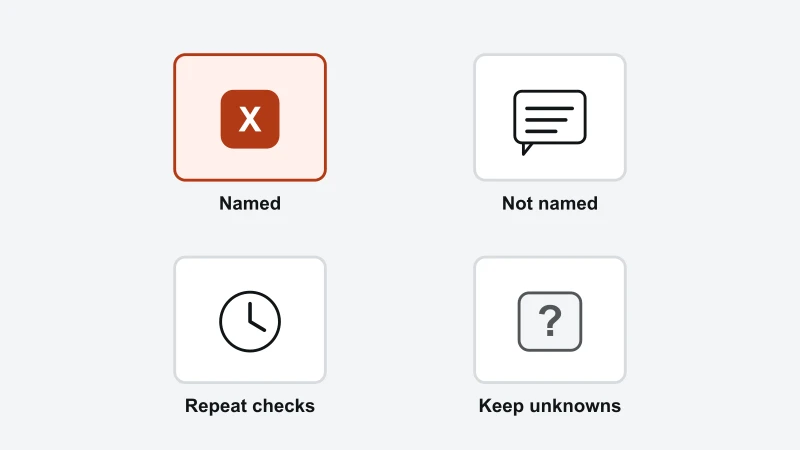
Record citations and brand mentions as separate results, because they rarely arrive together across the major AI platforms. In the Semrush study with Kevin Indig, ChatGPT cited a brand it appeared with far more often than it named it, and Gemini did the reverse.
RankX AI's AI Visibility asks your buyers' prompts on ChatGPT, Gemini, Claude and Perplexity on the schedule you choose, and store projects start with ChatGPT, Gemini and Perplexity, with Claude on request. Google AI Overviews are reported on their own screen, which is the distinction this article is built on.
Before committing to tracking, two checks are free. The AI Readiness Score checks whether a single URL can appear in AI search results at all and shows what to fix, and the AI Crawler Access Checker shows which AI crawlers your robots.txt lets in.
Choose one buying task and the assistant your evidence supports
Pick one product family and a small set of questions that affect selection. Review customer questions, identifiable referrals and available answer observations to decide where to start.
Do not divide the budget equally across assistants merely because a dashboard lists them, and do not assume a channel with no recorded visits has no influence.
Use one useful category, product or guide as the intended owner of each distinct task. Improve a confirmed access, factual or navigation gap, then repeat a stable panel on the chosen surface.
Report what was observed and what remains unknown. Add another assistant when the team can review the extra evidence, not when another blended visibility score looks attractive.
Next, build the buyer-question panel or compare SEO, GEO and AEO priorities.
Questions about AI Platform Guides
Do you need to rank in Google to rank in AI search?
Not for the query a person actually types, and less than a year ago. Ahrefs found 37.1 per cent of AI Overview citations ranked in Google's top 10 in March 2026, down from 76 per cent in July 2025, and a separate Ahrefs study of 15,000 long-tail queries found an average of 11.9 per cent of assistant-cited URLs in the top 10. Being indexed where the platform retrieves from is the floor; a top 10 position is neither required nor sufficient.
Do I need separate strategies for Google AI Overviews and ChatGPT?
You need one shared floor and separate measurement. Google AI Overviews is a results page feature drawn from Google's index and triggered by keywords, while ChatGPT is an assistant that retrieves from an index OpenAI builds and is reached by conversation. Crawl access, answer-first sections and third-party mentions help both, but track them on separate screens.
Which AI platform should you optimise for first?
Start where your customer evidence and your ability to act overlap: support questions, identifiable referrals and relevant answer observations. If that evidence is sparse, run one bounded pilot and state the uncertainty. Audience size alone does not decide the best channel for a particular catalogue.
Is ranking in Google AI Overviews the same as ranking in AI search?
No, and treating them as one is the most common error in guides on this subject. Google AI Overviews is a feature of a search results page, triggered by keywords and drawn from Google's index. The assistants are separate products with their own retrieval, so the two need separate tracking.
How long does it take to appear in AI search results?
No fixed timetable applies across platforms, because access, retrieval and answer selection are different steps and a crawler request does not prove inclusion. Save the change, then repeat comparable questions with the assistant and market noted. Report what changed in the observed panel without promising the same result to another store.
Sources
- Ahrefs, Update: 38% of AI Overview Citations Pull From The Top 10 (863K SERPs, 4M URLs) (opens in a new tab) Checked 2026-10-01.
- Ahrefs, Only 12% of AI Cited URLs Rank in Google's Top 10 for the Original Prompt (opens in a new tab) Checked 2026-10-01.
- Ahrefs, Why ChatGPT Cites Pages (1.4M prompts) (opens in a new tab) Checked 2026-10-01.
- Moz, Only 12% of AI Mode Citations Match URLs in the Organic Results (nearly 40,000 queries) (opens in a new tab) Checked 2026-10-01.
- Ahrefs, How to Rank in AI Overviews, published 20 January 2026, still stating 76 per cent from 1.9 million citations (opens in a new tab) Checked 2026-10-01.
- SEranking, AI Overviews research, 18,767 keywords, 19 November 2024: 92.36 per cent of AI Overviews link to at least one top-10 domain (opens in a new tab) Checked 2026-10-01.
- Goodie, 2026 AI Search Traffic Report, wave 1 (May to August 2025) covering 41 brand sites and 2.8 million AI referral sessions, wave 2 brand-averaged for March to April 2026 (opens in a new tab) Checked 2026-10-01.
- Similarweb, AI search stats: generative AI web traffic share to May 2026 (opens in a new tab) Checked 2026-10-01.
- Semrush with Kevin Indig, the ghost citations study, 3,981 domain appearances across 115 prompts, 14 countries and 4 engines, published 9 June 2026 (opens in a new tab) Checked 2026-10-01.
- Profound, ChatGPT and Perplexity citation overlap (100K prompts) (opens in a new tab) Checked 2026-10-01.
- Anthropic, subprocessor list: Brave Search, web search, all products (opens in a new tab) Checked 2026-10-01.
- Ahrefs, AI Mode and AI Overviews cited the same URLs 13.7 per cent of the time: 540,000 query pairs, September 2025 US data, published 15 December 2025 (opens in a new tab) Checked 2026-10-01.
- Anthropic, Claude crawler documentation (Claude-SearchBot, Claude-User) (opens in a new tab) Checked 2026-10-01.
- OpenAI, bot documentation (OAI-SearchBot, GPTBot, ChatGPT-User) (opens in a new tab) Checked 2026-10-01.
- Perplexity, bot documentation (PerplexityBot, Perplexity-User) (opens in a new tab) Checked 2026-10-01.
- Google, AI features and your website (fan-out, snippet controls) (opens in a new tab) Checked 2026-10-01.
- SparkToro, AI brand-recommendation consistency (2,961 runs) (opens in a new tab) Checked 2026-10-01.
- Tow Center for Digital Journalism, Columbia, AI search citation accuracy (1,600 queries) (opens in a new tab) Checked 2026-10-01.
- Microsoft Bing, Introducing AI Performance in Bing Webmaster Tools Public Preview, 10 February 2026: citations across Microsoft Copilot, AI-generated summaries in Bing and select partner integrations (opens in a new tab) Checked 2026-10-01.
- Bing Webmaster Guidelines, Microsoft: Bing and Copilot search experiences rely on the same core crawling, indexing and ranking foundation as traditional search (opens in a new tab) Checked 2026-10-01.
- Google Search Central: ecommerce site structure (opens in a new tab) Checked 20 Oct 2026.
- Google Search Central: current generative AI optimisation guidance (opens in a new tab) Checked 2026-10-21.
Asif Syed is the founder and CEO of RankX AI, the AI search visibility platform. He builds the product and writes here about GEO, AI search measurement and WordPress.
CoversThis article covers the AI Platform Guides topic, the AI Visibility feature and the AI Readiness Score tool.
Terms usedAnswer Engine, Grounding, RAG (Retrieval-Augmented Generation), Query Fan-Out, AI Citation, AI Mention, AI Overview, Google AI Mode, OAI-SearchBot, ClaudeBot, PerplexityBot, Google-Extended, Citation Rate and Chunking.
Read this page asMarkdown: /blog/how-to-rank-in-ai-search.md.
All articlesEverything RankX AI publishes is listed on the blog index.
Ask an assistantAsk ChatGPT (opens in a new tab), Ask Claude (opens in a new tab) or Ask Perplexity (opens in a new tab).
Preferred sourceIf Google is your front door, you can add RankX AI as a preferred source (opens in a new tab), which asks your own results to surface more of what we publish.