Google Gemini SEO: How Gemini Picks Sources
Gemini grounds its answers in Google Search, and a separate robots.txt token decides whether you are eligible. What Google documents, and the three controls.
 Published Last updated 12 minute read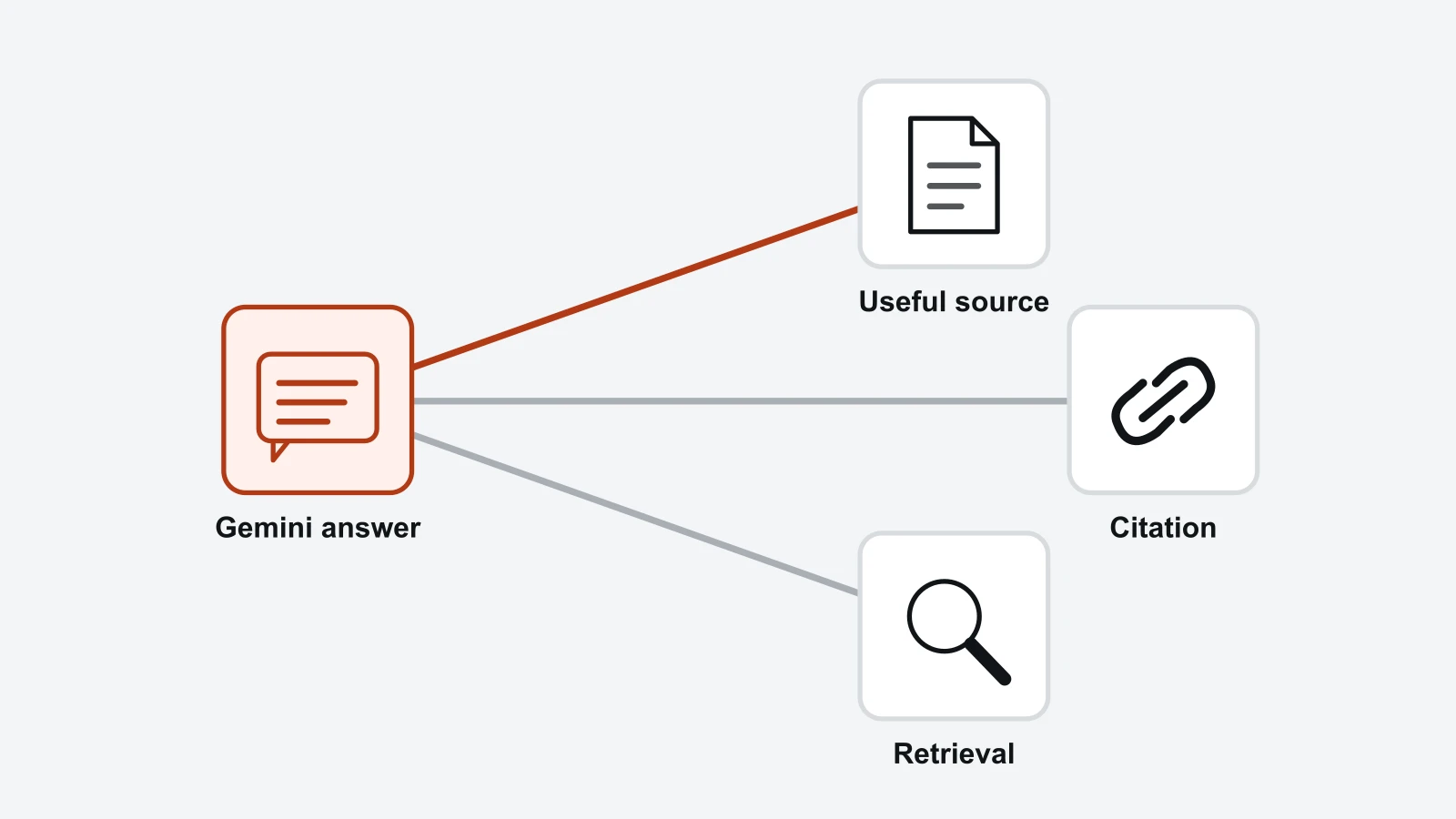
On this page 11 sections
- What is Gemini SEO?
- Gemini and AI Overviews are different surfaces with different controls
- The mistakes this distinction prevents
- Does Google Gemini have its own crawler or index?
- Does ranking in Google get you cited by Gemini?
- Google has published requirements for AI Overviews and none for Gemini
- Which parts of traditional SEO carry over to Gemini?
- How to work on Gemini visibility, in order
- How to measure Gemini visibility in AI search
- How RankX AI tracks Gemini
- Test a buying question Gemini can answer with facts
Short answer: For Gemini visibility, distinguish the Gemini assistant from AI Overviews and AI Mode in Google Search. Check the current documented controls for the relevant surface, make important product facts accessible and inspect the actual answer and cited destination. A crawler or grounding preference controls permitted use; it does not require Gemini to cite or recommend your store.
What is Gemini SEO?
Google Gemini SEO is the practice of getting your pages retrieved and cited by Gemini, Google's AI assistant. The unit of visibility is a mention or a citation inside a written answer, not a position in a list of search results, so a page is either in the answer or it is absent from it.
The first job is deciding which Google surface you actually mean. Google runs at least three things people call Google AI: Google AI Overviews at the top of a search results page, AI Mode as a conversational tab inside the search engine itself, and the Gemini assistant as a separate app and API. They are not interchangeable, and the first two are further apart than they look: AI Mode and AI Overviews compared.
Getting that wrong is expensive rather than academic. The two families answer to different controls, they are measured in different places, and one of them reports into Search Console while the other reports nowhere at all. Most AI search advice on this subject treats them as one system.
Gemini and AI Overviews are different surfaces with different controls
Gemini and AI Overviews answer to different controls. Three of them exist. Most published guides describe two, and Google documents each one in a separate place, which is most of why the field keeps merging them.
- Gemini
An assistant answer to inspect.
- AI Overviews
A separate search-result surface.
- Controls
Verify which crawler or setting applies.
Similar branding does not make these surfaces interchangeable.
Google's AI features documentation (opens in a new tab) states the Search half: AI is built into Search and integral to how Search functions, which is why robots.txt directives for Googlebot are the control site owners use to manage access. The preview controls that apply are nosnippet, data-nosnippet, max-snippet and noindex.
Google's crawler documentation states the Gemini half just as directly. Google-Extended governs Gemini Apps, the Vertex AI API for Gemini, and grounding in both. It then adds the sentence that settles the question: Google-Extended does not impact a site's inclusion in Google Search, nor is it used as a ranking signal in Google Search.
A third control arrived on 31 August 2026 and most published advice predates it. Search Console now carries a Search generative AI setting, under Settings, offering Include, Exclude or Inherit, and it covers AI Overviews, AI Mode and generative AI in Discover. Google states that it affects only those features and is not used as a ranking or inclusion signal elsewhere in Search.
Surface | What governs access | What excluding yourself costs |
|---|---|---|
AI Overviews and AI Mode | The Search generative AI setting in Search Console | Those features only. Google states it is not a ranking or inclusion signal for the rest of Search |
AI Overviews and AI Mode | Googlebot, via robots.txt and the preview controls | Your place in Google Search as a whole, since the same token serves both |
Gemini assistant and Vertex AI | Google-Extended in robots.txt | Grounding and training eligibility for Gemini, with Search untouched |
That setting is now an eligibility condition as well as an opt-out. Google's generative AI optimisation guide (opens in a new tab), updated 10 July 2026, says a site must be included in Search generative AI features in Search Console to be eligible for display in them, on top of the ordinary requirement to be indexed and snippet-eligible.
The mistakes this distinction prevents
Blocking Google-Extended to stay out of Google's AI answers does not work, because it leaves AI Overviews running exactly as before. Google-Extended reaches the assistant and the Vertex API, and Google says in terms that it carries no weight in Search. AI Overviews are part of Search.
The reverse error costs more. Blocking Googlebot does remove you from AI Overviews and AI Mode, and it removes you from ordinary Google results in the same stroke, because that token serves both at once. For most of the period this subject has been written about, that was the whole choice available.
The third error is now the commonest, and it is quoting the old answer. Guides published before 31 August 2026 say no setting keeps the blue links and drops the AI summary. That was true and is not: the Search Console control does precisely that, for AI Overviews and AI Mode, on Google's own statement that it carries no weight elsewhere in Search. It still does nothing about Gemini.
So three controls reach three different things, and only one of them is a general opt-out from Google's AI answers in Search. None of them opts you out of everything Google labels AI. Our AI Crawler Access Checker reads a live robots.txt against both tokens and more than twenty other AI agents.
Does Google Gemini have its own crawler or index?
Google Gemini has neither a crawler of its own nor a search index of its own. This is the most commonly misstated fact about the platform. Google's crawler documentation says Google-Extended has no separate HTTP request user agent string, that crawling is done with existing Google user agent strings, and that the token is used in a control capacity.
One practical consequence follows immediately. Google-Extended will never appear in a server log, because nothing by that name ever requests a page. A log-based crawler audit cannot confirm or deny that your Google-Extended rule is working, and the only way to check it is to read the robots.txt you are actually serving.
For reaching the live web, Gemini uses grounding. Google's Gemini API documentation (opens in a new tab) describes Grounding with Google Search as connecting the model to real-time web content, returning grounding metadata and inline citation annotations alongside the answer.
The detail worth carrying away is that Gemini decides whether to search at all. Google's wording is that the AI model analyses the prompt and determines if a Google Search can improve the answer. A question it answers without searching is answered from training data, which was fixed at the model's knowledge cutoff and which nothing you publish this month can change. No amount of SEO reaches an answer the model never searched for.
Does ranking in Google get you cited by Gemini?
Ranking in Google predicts Gemini citations weakly, which is a strange result for an assistant grounded in Google Search. Ahrefs searched 15,000 long-tail queries (opens in a new tab) in early July 2025 and compared what four assistants cited against what ranked. Gemini's overlap was 8.6 per cent of cited URLs also ranking in Google's top 10. Perplexity was the outlier at 28.6.
The unquoted column in that study is the more useful one. For 84.9 per cent of the URLs Gemini cited, the page did not rank in Google's top 100 at all for the query that produced the answer. Not outside the top ten: absent from the first hundred results. A further 6.5 per cent ranked somewhere beyond position ten.
Query fan-out is the likeliest explanation, and Google names the technique in its own documentation. The answer is assembled from several related searches instead of the one you typed, so the pages Gemini reaches are often top results for questions the user never saw. Your ranking for the visible query is only loosely connected to whether you appear.
Two things follow for how you spend effort. Chasing position one on a head term optimises for a query Gemini may never issue, while covering the adjacent questions competently puts you in the searches it does. Note the age of the evidence as well: the measurement is fourteen months old and nobody has published a 2026 replication that separates the assistants this way.
From RankX AIInspect Gemini alongside a defined buying-question panel.If the answer names a product but sends the buyer to another shop, record that merchant destination rather than counting it as a visit for your store.Explore AI visibility trackingGoogle has published requirements for AI Overviews and none for Gemini
Google publishes eligibility rules for AI Overviews and AI Mode, and publishes nothing equivalent for the Gemini assistant. The asymmetry has widened rather than closed: Google shipped a dedicated optimisation guide for its Search AI features in July 2026 and a Search Console report for them in August, and produced neither for its own assistant. Our AI Overviews article sets out what those Search requirements say.
Check the scope of the sentence being quoted. Google's statement that you need no new machine readable files, no AI text files and no special schema.org data is made about AI Overviews and AI Mode, the two features inside Search. The Gemini assistant is a different product and appears nowhere in that guidance.
For Gemini itself Google documents exactly one lever, and it is a permission, not a technique. Google-Extended decides whether your content may be used for grounding and training in Gemini Apps. There is no published list of things a page should do to be selected once it is eligible.
Two conclusions follow, and the second is the uncomfortable one. Advice that cites Google's no-special-optimisation line as settled guidance for Gemini is quoting a Search document about a different surface. And anyone claiming to know what Gemini rewards is working from inference, because Google has not said.
Which parts of traditional SEO carry over to Gemini?
More of traditional SEO carries over to Gemini AI than to most assistants. The reason is structural, and it is not especially encouraging. Gemini reaches the web through Google Search, so the work that makes a page eligible for Google is the same work that makes it reachable for Gemini. Technical SEO is not a separate discipline here, and there is no Gemini-specific checklist that sits beside it.
The floor is the ordinary one. A page has to be crawlable by Googlebot, indexed, eligible for a snippet, and readable as text without JavaScript. A page that fails any of those is invisible to Google Search, to AI Overviews and to Gemini grounding at the same time, which makes technical SEO the cheapest AI-visibility work available.
Schema markup deserves a straight answer, because most SEO strategies aimed at Gemini lead with it. Google says no special structured data is required for its AI features, and it publishes nothing at all about schema and the Gemini assistant. Structured data still earns its place for rich results and for making entities unambiguous. No public evidence ties it to being cited by Gemini.
What changes is the unit of optimisation. Traditional SEO tunes a page to compete for a query, while Gemini lifts a passage out of a page and drops the rest. A section that only makes sense after three paragraphs of preamble is a section the assistant cannot use, which is why answer-first writing does more for Gemini than any markup does.
Two Google surfaces outside your own site count as well, and Google names them itself. Its generative AI guidance says Merchant Center feeds and Google Business Profile can help products and services appear in AI responses. Read the scope again before acting on it: that guidance covers the Search AI features, so it is AI Overviews work that happens to share a programme with Gemini.
The discipline that covers this across every assistant is Generative Engine Optimization, and Gemini is the platform where it overlaps most with the SEO a team already does. Treat the Gemini-specific work as a thin layer on top of that, rather than as a separate programme with its own budget.
How to work on Gemini visibility, in order
Gemini SEO work divides into the settled and the speculative. The settled comes first. The order below runs cheapest and most certain to most speculative, and most of it is ordinary SEO pointed at an AI search surface rather than a new discipline.
- Useful source
Resolve the underlying buyer question.
- Available content
Check access and factual clarity.
- Repeated checks
Inspect actual Gemini answers over time.
Traditional page improvements are inputs. A citation remains an observed outcome.
- Check the Search generative AI setting in Search Console, under Settings. It is newer than most published advice, it is now an eligibility condition for AI Overviews and AI Mode as well as an opt-out, and it takes about ten seconds to read. Include is the default. This step does nothing for Gemini and is here because people arrive looking for it.
- Decide the Google-Extended question deliberately. Read your live robots.txt and confirm whether you allow it. Blocking it removes Gemini grounding eligibility and, on Google's own statement, costs you nothing in Search. Allowing it is the default and is what most sites want.
- Confirm Googlebot is not restricted, by robots.txt or by a CDN or bot-management rule. This is the control that governs AI Overviews and AI Mode, and it is the one that also governs whether you are in Google at all.
- Serve the content in the HTML, while knowing Gemini is the one assistant that may cope without it. Because Gemini reaches the web through Google Search, it inherits Googlebot's rendering, so client-side content can survive here where it dies on the others. Google's rendering is deferred rather than guaranteed, and the other four assistants read raw HTML, so server-side rendering is still the right default. Treat Gemini as the exception that does not change the rule.
- Answer the question in the opening sentence of each section. Retrieval lifts passages without their surrounding context, so a section that builds to its conclusion gets extracted before the conclusion arrives.
- Name the entity instead of using pronouns across section boundaries. A chunk beginning "It supports" is unusable once separated from the heading above it.
- Earn coverage on pages that already rank for the fan-out questions, not only for your head term. Because Gemini assembles answers from several related searches, the pages it reaches are often ranking for questions adjacent to the one asked.
- Skip the AI-specific file work if Google's AI surfaces are the only goal. Google says no AI text file or extra schema is required. Publish llms.txt if you want it for other assistants, with clear eyes about what it is for.
How to measure Gemini visibility in AI search
Gemini assistant visibility does not appear in Search Console. That surprises SEO teams who assume every Google surface reports together. Search Console gained a dedicated generative AI performance report on 31 August 2026, breaking impressions down by page, country, date and device. It covers AI Overviews and AI Mode, the two features inside Search.
The Gemini assistant is absent from that report, and its absence is the point. Google shipped reporting for its Search AI features and nothing for its assistant, so the surface most people mean by Gemini is the one surface Google gives you no numbers for. Anyone quoting a Search Console figure as their Gemini visibility is reading AI Overviews.
So the two surfaces need two instruments. Google AI Overviews and AI Mode are measured in that report, against the pages you already track. The assistant has to be measured by asking the AI platform questions repeatedly and recording whether your brand appears, which is what a tracked prompt panel does.
Two cautions apply to any such panel, and both come from running one. Answers vary between identical runs, so a single check is close to meaningless and a rate over many checks is the only readable number. And the denominator moves whenever you add prompts, so a rate that falls after a panel expansion may record nothing except a larger denominator.
How RankX AI tracks Gemini
RankX AI is our own product. This is the part of the article where we describe it instead of the field. It runs a fixed set of prompts against Gemini, ChatGPT, Claude, Perplexity, Grok and Microsoft Copilot on a schedule you set, and records whether each answer names your brand. It reports the rate per platform with the check counts visible, so a rate is never read without its denominator.
It tracks Gemini and AI Overviews as separate things on purpose, for the reason this article opens with. Gemini is measured through the assistant run; AI Overviews tracking runs through the rank-tracking pipeline on tracked keywords, because that is the surface they belong to. Reporting them as one number would hide the fact that a site can do well in one and be absent from the other.
If you want the crawler-access half without signing up for anything, the AI Crawler Access Checker reads a live robots.txt against Google-Extended, Googlebot and the other AI agents and tells you what each one is currently allowed to do. The AI Visibility page covers the tracking side in full.
Test a buying question Gemini can answer with facts
Choose a product type with a constraint your catalogue genuinely supports, such as capacity, compatibility or care requirements. Keep the question and any available sources with the answer. Check the product facts against the public page; do not add a claimed certification, material or use case merely because an assistant suggested it.
If the answer names a product but sends the buyer to another shop, record that merchant destination rather than counting it as a visit for your store. Improve a relevant product or buying-guide page where a verified fact is missing, then repeat a comparable observation. Keep Gemini assistant results separate from Google AI Mode and AI Overviews, and verify the current documented crawler controls before changing them.
Next, separate Google AI surfaces or measure repeated answers.
Questions about AI Platform Guides
Is Gemini SEO different from optimising for AI Overviews?
Yes, and three separate controls are involved rather than two. AI Overviews and AI Mode are part of Search: they answer to Googlebot via robots.txt and the preview controls, and since 31 August 2026 also to a Search generative AI setting in Search Console that includes or excludes a site from those features alone. The Gemini assistant answers to Google-Extended, which governs training and grounding for Gemini Apps and the Vertex AI API. Google states that Google-Extended does not affect inclusion or ranking in Google Search, so blocking it removes you from Gemini grounding while leaving AI Overviews untouched.
Does Google-Extended show up in server logs?
No, and that surprises people running log-based crawler audits. Google's crawler documentation states that Google-Extended has no separate HTTP request user agent string, that crawling is done with existing Google user agent strings, and that the robots.txt token is used in a control capacity only. Nothing called Google-Extended ever fetches a page, so it cannot appear in a log file. You verify it by reading your robots.txt, not your access log.
Does Gemini have its own web crawler or index?
No separate crawler, and it reaches the web through Google Search. Google's own documentation describes Grounding with Google Search as connecting the model to real-time web content, with the model deciding whether a search would improve the answer before running one. Google-Extended has no user agent of its own and relies on existing Google crawlers. A question that does not trigger a search is answered from training data instead, where nothing you change on your site can reach it.
Do you need llms.txt or extra schema to appear in Google's AI answers?
Not according to Google. Its AI features documentation, last updated 10 December 2025, says you do not need to create new machine readable files, AI text files, or markup to appear in these features, and that there is no special schema.org structured data you need to add. Read the scope carefully: that statement covers AI Overviews and AI Mode inside Google Search. It is not a claim about ChatGPT, Perplexity or Claude, which publish their own guidance and behave differently.
Does ranking in Google get you cited by Gemini?
It helps and it is a weak predictor. Ahrefs searched 15,000 long-tail queries in early July 2025 and compared what four assistants cited against what ranked. Gemini's overlap was 8.6 per cent of cited URLs also ranking in Google's top 10, against 28.6 per cent for Perplexity, the outlier. The more striking figure from the same study is that 84.9 per cent of the pages Gemini cited did not rank in Google's top 100 at all for the query that produced the answer, which is what query fan-out would predict.
How long does it take to show up in Gemini?
Google publishes no figure for this, and anyone quoting a specific number is guessing. The binding constraint is Google's crawl and index cycle, because Gemini grounds through Google Search rather than a crawler of its own. Google's own documentation says recrawling can take anywhere from several days to several months, depending on how often its systems decide a page needs refreshing. A page nobody has recrawled reaches Gemini at the speed of that recrawl, whatever you changed on it.
Can you measure Gemini visibility in Search Console?
Only for AI Overviews and AI Mode, not for the Gemini assistant. Search Console gained a dedicated generative AI performance report on 31 August 2026, with impressions broken down by page, country, date and device, and it covers those two Search features. The Gemini app is a separate product and reports nothing there, so the only way to measure it is to ask it questions repeatedly and record whether your brand appears, which is what a tracked prompt panel does. A Search Console number quoted as Gemini visibility is really AI Overviews.
Sources
- Google Search Central, AI features and your website, last updated 10 December 2025. Exact wording: 'AI is built into Search and integral to how Search functions, which is why robots.txt directives for Googlebot is the control for site owners to manage access to how their sites are crawled for Search'; 'To limit the information shown from your pages in Search, use nosnippet, data-nosnippet, max-snippet, or noindex controls'; 'To limit AI training and grounding in some of Google's other systems, read more about Google-Extended'; 'To be eligible to be shown as a supporting link in AI Overviews or AI Mode, a page must be indexed and eligible to be shown in Google Search with a snippet, fulfilling the Search technical requirements. There are no additional technical requirements'; 'You don't need to create new machine readable files, AI text files, or markup to appear in these features. There's also no special schema.org structured data that you need to add'; 'Both AI Overviews and AI Mode may use a query fan-out technique, issuing multiple related searches across subtopics and data sources, to develop a response'; 'AI Overviews are only shown when our systems determine that it is additive to classic Search, and as such, often don't trigger'; and on measurement, that sites appearing in AI features 'are included in the overall search traffic in Search Console' and 'reported on in the Performance report, within the Web search type' (opens in a new tab) Checked 2026-09-07.
- Google Search Central, Google crawlers and user-triggered fetchers. Exact wording: 'Google-Extended doesn't have a separate HTTP request user agent string. Crawling is done with existing Google user agent strings; the robots.txt user-agent token is used in a control capacity' and 'Google-Extended does not impact a site's inclusion in Google Search nor is it used as a ranking signal in Google Search'. Products controlled: Gemini Apps, Vertex AI API for Gemini, and grounding features in Gemini Apps and Grounding with Google Search on Vertex AI (opens in a new tab) Checked 2026-09-07.
- Google, Grounding with Google Search (Gemini API documentation): grounding 'connects the Gemini model to real-time web content', 'The model analyzes the prompt and determines if a Google Search can improve the answer', responses carry grounding metadata and inline url_citation annotations, and the stated benefit is to 'Reduce model hallucinations by basing responses on real-world information' (opens in a new tab) Checked 2026-09-07.
- Ahrefs (Louise Linehan, with Xibeijia Guan), AI search overlap: 15,000 long-tail queries searched in Google and Bing and asked of ChatGPT, Gemini, Copilot and Perplexity. Data collected early July 2025, published 11 August 2025. Google, top 10 / beyond top 10 / not ranked: Perplexity 28.6 / 7.3 / 64.1, ChatGPT in-text 8.0 / 8.8 / 83.2, ChatGPT references 6.1 / 9.2 / 84.7, Gemini 8.6 / 6.5 / 84.9, Copilot 8.2 / 5.1 / 86.7. Bing: Copilot 16.6 / 6.3 / 77.1, Perplexity 14.0 / 5.5 / 80.5, ChatGPT in-text 8.1 / 5.0 / 86.9, ChatGPT references 8.1 / 5.2 / 86.7, Gemini 3.3 / 3.8 / 92.9. Gemini: 8.6 per cent in Google's top 10 and 84.9 per cent not ranked at all in the top 100 (opens in a new tab) Checked 2026-09-07.
- Google Search Central, Top ways to ensure your content performs well in Google's AI experiences on Search, last updated 10 July 2026. Exact wording: 'In addition to the technical requirements for Search, a site must be included in Search generative AI features in Search Console to be eligible for display in generative AI features on Google Search', and 'To be eligible to be shown in generative AI features on Google Search, a page must be indexed and eligible to be shown in Google Search with a snippet'. Also: 'Google is able to process content within JavaScript as long as it isn't blocked'. The page also names Merchant Center and Google Business Profile as helping products and services appear in AI responses (opens in a new tab) Checked 2026-09-07.
- Google Search Console Help, Search generative AI control. 'As of August 31, 2026, we've rolled out this control to all websites worldwide.' Lives at Settings > Search generative AI; options are Include (default), Exclude, and Inherit from parent property; it covers AI Overviews, AI Mode and generative AI features in Google Discover. A partial opt-out: 'This control only affects whether your content can appear in certain Search generative AI features; this control isn't used as a ranking or inclusion signal affecting other parts of Search.' And: 'To limit training of the models used to generate responses in Search generative AI features, use Google-Extended' (opens in a new tab) Checked 2026-09-07.
- Google Search Console Help, Generative AI performance report. 'As of August 31, 2026, we've rolled out these insights to all websites worldwide.' Reports impressions from AI Overviews and AI Mode, grouped by Pages, Countries, Dates and Devices. Excludes Discover, which has its own report, and Search Labs experiments. The report covers Google's two Search AI features and says nothing about the Gemini assistant (opens in a new tab) Checked 2026-09-07.
- Google Search Central: ecommerce site structure (opens in a new tab) Checked 20 Oct 2026.
Asif Syed is the founder and CEO of RankX AI, the AI search visibility platform. He builds the product and writes here about GEO, AI search measurement and WordPress.
CoversThis article covers the AI Platform Guides topic, the AI Visibility feature and the AI Crawler Access Checker tool.
Terms usedGoogle-Extended, Google AI Mode, AI Overview, Grounding, Query Fan-Out, AI Citation, AI Mention, Robots.txt, Schema Markup (Structured Data), llms.txt, Training Data and Knowledge Cutoff.
Read this page asMarkdown: /blog/gemini-seo.md.
All articlesEverything RankX AI publishes is listed on the blog index.
Ask an assistantAsk ChatGPT (opens in a new tab), Ask Claude (opens in a new tab) or Ask Perplexity (opens in a new tab).
Preferred sourceIf Google is your front door, you can add RankX AI as a preferred source (opens in a new tab), which asks your own results to surface more of what we publish.