Google AI Mode vs AI Overviews: What Differs
Google AI Mode and AI Overviews cite the same URLs 13.7 per cent of the time, on Ahrefs data. What that means for SEO, and what Google documents about both.
 Published Last updated 13 minute read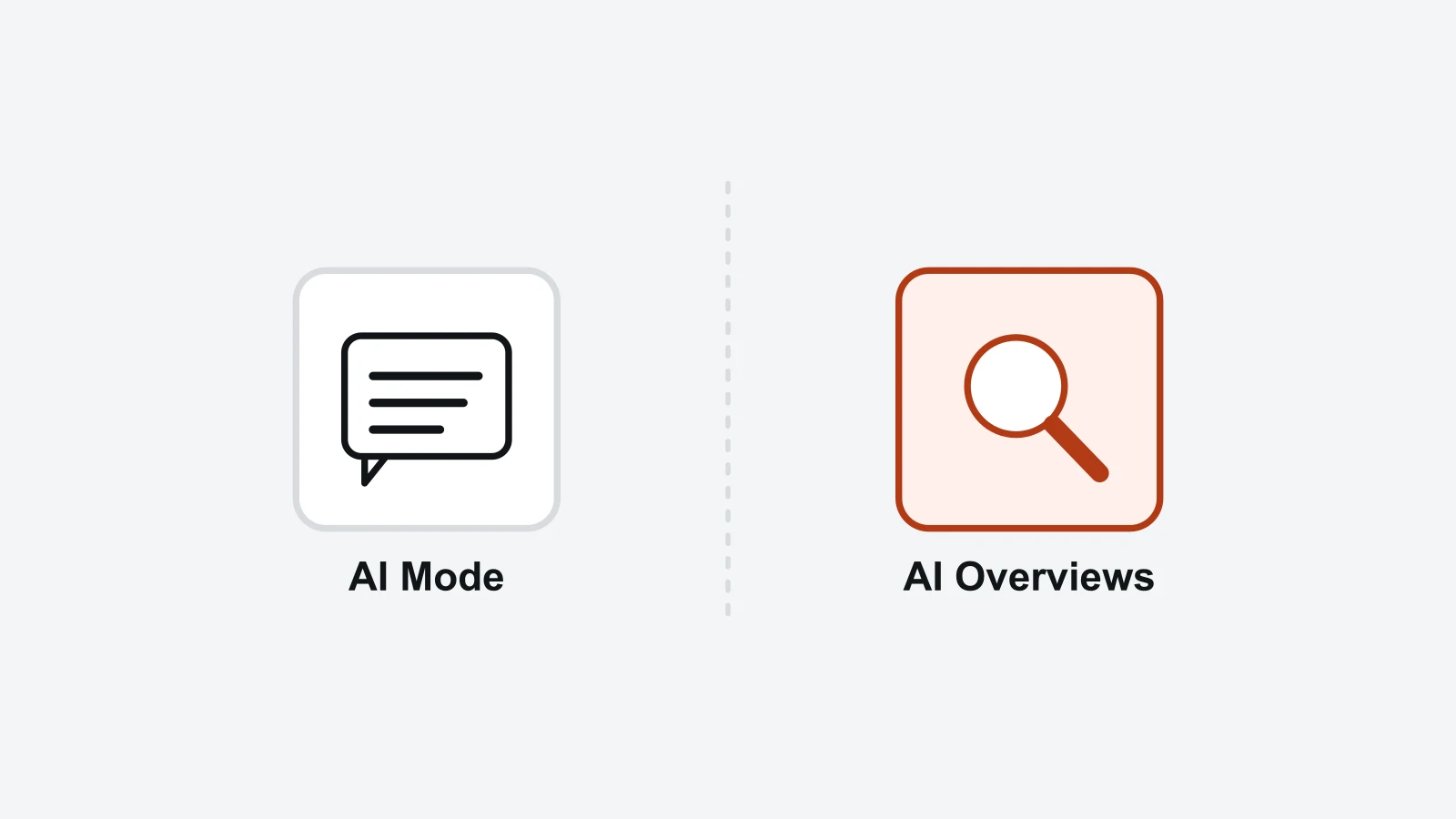
On this page 11 sections
- What is the difference between Google AI Mode and AI Overviews?
- Do Google AI Mode and AI Overviews cite the same sources?
- How different is 13.7 per cent overlap, really?
- Which sources does each Google AI surface prefer?
- Do you need a separate SEO strategy for Google AI Mode?
- Does query fan-out make Google AI Mode different?
- If you appear in an AI Overview, will you appear in AI Mode?
- Can you measure Google AI Mode and AI Overviews separately?
- What has changed since the AI Mode citation data was collected?
- How RankX AI tracks Google AI Overviews
- Record the result type before calling it shopping visibility
Short answer: AI Overviews and AI Mode are different experiences within Google Search. They can use different responses and sources, so record which surface you observed. Both depend on the documented Search eligibility and content controls. Build useful accessible pages for the reader, then measure the two experiences separately rather than treating one citation as proof of visibility in both.
What is the difference between Google AI Mode and AI Overviews?
The difference is where each one meets the reader. Google AI Overviews are AI-generated summaries that sit above the classic blue links on a traditional search, arriving whether or not anyone asked for them. Google AI Mode is a conversational surface you enter deliberately, built for follow-up questions and comparisons. Neither is a separate product from Google Search.
- AI Mode
A conversational search experience.
- AI Overviews
An answer within ordinary search results.
- Measurement
Record the surface that produced the citation.
Do not combine the two surfaces into one unexplained visibility number.
Google describes the split by the job each does. AI Overviews exist to get someone to the gist of a complicated question quickly, and Google says they appear only where its systems judge them additive to classic Search, so they often do not trigger. AI Mode is aimed at questions needing exploration, reasoning or comparison that would previously have taken several searches.
Both surfaces sit on the same foundation, which is the part most comparisons skip. Google states that its generative AI features on Search are rooted in its core Search ranking and quality systems, and that they highlight content from the Search index using retrieval-augmented generation, the technique also called grounding.
Dimension | Google AI Overviews | Google AI Mode |
|---|---|---|
Where it appears | Above classic results on a normal search | A separate conversational surface in Search |
When it appears | Only when Google judges it additive, so often not at all | When the user chooses it |
Typical length | Short summary | Roughly four times longer, on Ahrefs data |
Brands named per answer | 1.3 on average | 3.3 on average |
Query fan-out | May be used | May be used |
Eligibility | Indexed and snippet-eligible | Indexed and snippet-eligible |
Robots and snippet controls | Googlebot directives | Googlebot directives |
Search Console reporting | Generative AI features, impressions only | Generative AI features, impressions only |
The one difference Google documents in the retrieval itself is deliberately vague, and it is the licence for everything below. Google states that AI Mode and AI Overviews may use different models and techniques, so the set of responses and links they show will vary. That is a much narrower claim than the field usually makes on Google's behalf.
Do Google AI Mode and AI Overviews cite the same sources?
Mostly they do not. Ahrefs compared both surfaces on the same queries (opens in a new tab) and found they cited the same URL only 13.7 per cent of the time. Looking at just the top three citations from each lifted it to 16.3 per cent, which is still low enough that the two rarely agree on a source.
The study is worth stating properly, because most pages quoting it do not. Ahrefs analysed 540,000 query pairs for the citation and URL analysis and 730,000 for content similarity, drawn from its Brand Radar dataset. The data is September 2025 US data, and the study was published on 15 December 2025. Publication date and collection date are three months apart, and the collection date is the one that matters.
What makes the finding interesting is that the disagreement is about sources rather than about substance. The same study measured 86 per cent average semantic similarity between the two answers, with 89.7 per cent of response pairs scoring above 0.8 on cosine similarity. Ahrefs summarised it as the two surfaces agreeing on what to say nine times out of ten while citing different places for it.
Word-level overlap was low too, at a Jaccard similarity of 0.16. The two produced an identical opening sentence 2.51 per cent of the time and an identical response 0.51 per cent of the time. So AI Mode is not an expanded AI Overview, and Ahrefs went in expecting that it might be.
How different is 13.7 per cent overlap, really?
A 13.7 per cent overlap between Google AI Mode and AI Overviews is a large difference, and the way that number is usually reported makes it impossible to judge. The common rendering is that 87 per cent of the time the two surfaces use completely different sources, measured against an implied 100 per cent. That baseline is wrong, because an AI Overview does not agree with itself between runs either.
Ahrefs measured that separately, in a study nobody pairs with the overlap one (opens in a new tab). Analysing more than 43,000 keywords that each had at least 16 recorded AI Overviews over a month, it found that consecutive AI Overviews for the same query share only 54.5 per cent of their cited URLs. Nearly half the sources change from one observation to the next, and the content changes roughly every 2.15 days.
Setting those side by side gives the figure a scale. Two different Google surfaces agree on 13.7 per cent of cited URLs. One Google surface agrees with its own previous answer on 54.5 per cent. The gap between the surfaces is roughly four times the gap a single surface opens with itself, which is what makes the case that they are genuinely separate retrieval systems rather than one system observed twice.
Treat that as a reference point rather than a controlled comparison, because the two studies were not built to be compared. They use different samples, different windows and different measurements: cross-surface overlap on single generations against same-surface overlap on consecutive generations. Ahrefs makes the underlying point itself, noting that citation pools may overlap more than a single-snapshot comparison suggests.
The practical consequence is about how you read your own data. A brand that appears in an AI Overview one week and not the next has probably observed normal churn rather than a ranking change, and the same caution applies with more force when comparing across the two surfaces. One check of one query is close to worthless as evidence on either.
Which sources does each Google AI surface prefer?
The two surfaces lean towards different kinds of site, and the directions are consistent rather than dramatic. In Ahrefs' data, AI Overviews showed a stronger preference for video and for community platforms like Reddit, with YouTube holding the top position in its citations, cited more often than encyclopedic sources.
AI Mode leaned the other way, towards reference and detail. Wikipedia appeared in 10 per cent more AI Mode citations than AI Overview citations, Quora appeared 3.5 times more often, and health sites and Facebook were each cited about twice as often. Reddit was the exception, cited a similar amount by both. AI Overviews cited videos and core pages, meaning homepages and main category pages, close to twice as often as AI Mode.
Our own AI Overview panel points the same way on video, on a much smaller sample. Across the 100 most recent AI Overview citations RankX AI recorded for five tracked keywords in the 30 days to 8 September 2026, youtube.com was the most cited domain at 28, more than five times the next domain at 5.
That is corroboration of a direction and not a measurement of the web, and the limits matter. Five keywords in a single niche is a narrow panel, and one of them is ambiguous with a Power BI function, which pulls unrelated documentation sites into the results. It agrees with Ahrefs on the point where agreement is cheap to check.
The useful conclusion is about format rather than about surface. If a topic supports a genuinely good video, that video has a better chance in AI Overviews than the equivalent page does, and neither finding suggests writing two versions of the same article.
Do you need a separate SEO strategy for Google AI Mode?
No, on everything Google documents. This is where the evidence parts company with most of the advice written about the pair, including advice built on the same citation study quoted above. Different sources do not imply different work when both AI systems are sitting on the same eligibility rules and the same ranking substrate.
Google states one eligibility bar and applies it to both. To be shown as a supporting link in AI Overviews or AI Mode, a page must be indexed and eligible to be shown in Google Search with a snippet, and Google says plainly that there are no additional technical requirements. Its July 2026 guide adds one more condition covering both surfaces together: the site must be included in Search generative AI features in Search Console.
The controls are shared too. Google's position is that AI is built into Search, which is why robots.txt directives for Googlebot are the control for how sites are crawled for Search, with nosnippet, data-nosnippet, max-snippet and noindex limiting what can be shown. There is no directive that admits you to one surface and excludes you from the other.
Google also addresses the vocabulary directly, which is unusual. On the terms answer engine optimisation and generative engine optimisation, it says that from Google Search's perspective optimising for generative AI search is optimising for the search experience, and is therefore still SEO. Take that as a statement about Google's surfaces only. Other assistants publish their own guidance and behave differently, which is the subject of the pillar on ranking in AI search.
None of this makes the two surfaces interchangeable to a reader or to a marketer. It means the lever is the same one: be snippet-eligible on the sub-questions a topic genuinely contains, and be worth quoting once you are. What differs is the odds, and the shape of the answer you land in.
From RankX AIInspect the Google search evidence for the query.Inspect the destination and what it helps the buyer do.Explore AI Overview trackingDoes query fan-out make Google AI Mode different?
No, because both surfaces use it. This is the most common factual error in comparisons of the two, and it is easy to check. Google's documentation states that both AI Overviews and AI Mode may use a query fan-out technique, issuing multiple related searches across subtopics and data sources.
Google defines the mechanism in its optimisation guide as a set of concurrent related queries the model generates to fetch additional relevant search results. Its worked example is the query "how to fix a lawn that's full of weeds" fanning out into searches such as best herbicides for lawns, removing weeds without chemicals, and preventing weeds in lawn.
Fan-out does explain why so few cited pages rank for the original query, on either surface. The pillar covers that evidence for AI Mode specifically, including Moz's finding on AI Mode citations and organic results, and the same pattern shows up in AI Overviews.
Where this turns into a trap is the advice that usually follows. A common recommendation is to write dedicated content targeting predicted fan-out queries. Google names that as a spam policy violation. Its optimisation guide (opens in a new tab) warns against creating separate content for every variation of how people might search, giving "other queries that people have asked, or fan-out queries" as its own example. Doing so primarily to manipulate rankings or generative AI responses violates its scaled content abuse policy.
Google adds that it is ineffective as well as against policy. A high quantity of pages does not make a site higher quality or more relevant, and Google says its systems have improved at understanding a page's relevance even without an exact query match. Covering the sub-questions a topic genuinely contains, on one good page, is the version of this that is not spam.
If you appear in an AI Overview, will you appear in AI Mode?
Usually, and with more competition around you. Ahrefs found that 61 per cent of the time, AI Mode included every entity the AI Overview had mentioned and then added more on top. Appearing in one is a reasonable predictor of appearing in the other, even though the cited URLs differ.
- Seen in Overview
Keep the query, answer and source evidence.
- Check AI Mode
Run the corresponding surface-specific observation.
- Report separately
An untested surface stays untested.
Do not infer AI Mode visibility from an AI Overview alone.
The reason is length. AI Mode responses are roughly four times longer and mention 3.3 brand or person entities on average, against 1.3 for AI Overviews. A longer answer has room for more names, so the same brand tends to survive the transition while sharing the space with sources that did not make the AI Overview.
That gap matters when reading an AI visibility report. An AI mention in AI Mode is worth less per mention than one in an AI Overview, because it is one of several rather than one of one, and a blended score across both surfaces will hide the difference. The distinction between a mention and an AI citation is separate again and covered in how AI assistants choose what to cite.
Both surfaces also answer without naming anyone a great deal of the time. In Ahrefs' dataset 59.41 per cent of AI Overview responses and 34.66 per cent of AI Mode responses contained no brand or entity at all, so the most likely outcome on either surface is that nobody gets named. AI Mode failed to cite any source 3 per cent of the time, against 11 per cent for AI Overviews.
Can you measure Google AI Mode and AI Overviews separately?
Not from each other, and not in Search Console. Google's Search generative AI performance reports, announced on 3 June 2026 and rolled out to all websites worldwide on 31 August 2026, report impressions for generative AI features on Search as a single group that covers AI Overviews and AI Mode together.
The report gives impressions broken down by page, country, device and date, and that data is also folded into the overall Performance report under the Web search type. There is no filter that isolates one surface from the other, and clicks, click-through rate and average position still carry no AI breakdown at all. The detail on what that report will and will not answer belongs to tracking your presence in Google AI Overviews.
The consequence for anyone comparing the two is that Google's own reporting cannot settle the comparison. Separating them means running a fixed panel of queries against each surface and recording what came back, which is also the only way to see the run-to-run churn described above rather than mistaking it for a trend.
The click side of the comparison is served worse still, and this is the gap worth knowing about. What an AI Overview citation earns has been measured repeatedly and at scale, and what a Google AI Overview citation is actually worth collects those figures. For AI Mode there is no equivalent measurement. The click-through rate quoted for it across dozens of pages traces back only to other pages quoting it, with no published sample, window or method behind it anywhere in the chain.
So the honest position on AI Mode click behaviour is that nobody has published one worth quoting. Anybody comparing the commercial value of the two surfaces is comparing a well-measured number against an absent one, and the comparisons that circulate simply do not say so.
One consequence lands in every account whether or not you track either surface. Google folded AI Mode into the ordinary Web search type in June 2025, so a site's Web impressions have included AI Mode impressions ever since, with nothing in the default view marking them. Why Search Console shows impressions with no clicks covers what that did to impression baselines, alongside the two other reporting changes of the same period.
What has changed since the AI Mode citation data was collected?
Enough that the figures above should be read as a dated measurement rather than as current behaviour. The overlap study used September 2025 data, twelve months before this article, and Google has changed both surfaces materially since. No comparable study has been published on the current versions.
At Google I/O on 20 May 2026 (opens in a new tab), Google brought AI Overviews and AI Mode into one AI Search experience, so that a question can move from a results page with an AI Overview to a follow-up in AI Mode. Google said the change was live that day across desktop and mobile worldwide. Two systems the study treated as separate destinations are now two stages of one path.
Google also made Gemini 3.5 Flash the default model for AI Mode globally on the same day, and said AI Mode had passed one billion monthly users with queries more than doubling every quarter since launch. Swapping the AI models underneath a surface is exactly the kind of change that would move a citation overlap figure in either direction.
What has not changed is the documentation the strategic conclusion rests on. Google's AI features guidance still states that the two may use different models and techniques, still sets one eligibility bar for both, and its July 2026 optimisation guide still names fan-out targeting as scaled content abuse. The measurement has aged; the instruction has not.
How RankX AI tracks Google AI Overviews
RankX AI made the citation panel this article draws on, and the disclosure belongs on a page arguing that a fixed panel is the only honest method. AI Overviews tracking produced the YouTube figure above, because it stores the cited domain behind every check rather than only the verdict on our own site.
The AI Overview Checker answers a single keyword free with no account. For AI Mode, where Google publishes no per-surface reporting to anybody, the comparisons here rest on the published studies above. The method on the AI Overviews side is set out in tracking your presence in Google AI Overviews.
Record the result type before calling it shopping visibility
Try a useful buying question and retain the exact query, market, device and date. Note whether you observed an AI Overview, an AI Mode answer, a product result or a conventional organic link. A citation to a sizing guide and a merchant offer for a product answer different questions and should not share one success count.
Inspect the destination and what it helps the buyer do. If a guide is cited but an unavailable product is linked next, improve that journey rather than writing a second guide for the other AI surface. Repeat observations within each surface. Historical citation-overlap studies explain a sample, not a promise that your two results will match or that one surface always sends higher-value customers.
Next, review AI Overview eligibility or inspect shopping observations.
Questions about AI Platform Guides
What is the difference between Google AI Mode and AI Overviews?
AI Overviews are AI-written summaries that appear above the classic results on an ordinary Google search, and Google says they only show when its systems judge them additive, so they often do not trigger at all. AI Mode is a separate conversational surface inside Google Search built for follow-up questions and comparisons. Both are generative AI features of Google Search rather than separate products, and both draw on the same Search index and ranking systems.
Do Google AI Mode and AI Overviews cite the same sources?
Mostly not. Ahrefs compared 540,000 query pairs from September 2025 US data and found the two surfaces cited the same URL only 13.7 per cent of the time, rising to 16.3 per cent when only the top three citations from each were compared. Read that against a baseline rather than against 100 per cent: Ahrefs separately found that two consecutive AI Overviews for the same query share only 54.5 per cent of their cited URLs, so a single surface disagrees with itself a great deal too.
Do you need a separate SEO strategy for Google AI Mode?
No, on Google's documented requirements. Google states that to be eligible for either AI Overviews or AI Mode a page must be indexed and eligible to appear in Google Search with a snippet, and that there are no additional technical requirements. The same robots.txt and snippet controls govern both, one Search Console setting includes or excludes a site from both, and Google says its generative AI features are rooted in its core Search ranking and quality systems. The sources they pick differ; the work you do does not.
Does query fan-out only apply to Google AI Mode?
No, and this is the most common error about the pair. Google's own documentation states that both AI Overviews and AI Mode may use a query fan-out technique, which it defines as a set of concurrent related queries the model generates to fetch additional search results. Google's July 2026 optimisation guide also warns against writing separate content aimed at fan-out queries, saying that doing so to manipulate responses violates its scaled content abuse spam policy and is an ineffective long-term strategy.
If your brand appears in an AI Overview, will it appear in AI Mode?
Often, but you will have more company. Ahrefs found that 61 per cent of the time AI Mode included every entity the AI Overview mentioned and then added more on top, because AI Mode responses are roughly four times longer and carry 3.3 brand or person entities on average against 1.3 for AI Overviews. So appearing in one is a reasonable predictor of appearing in the other, while the share of attention inside an AI Mode answer is smaller.
Can you separate AI Mode from AI Overviews in Search Console?
Not from each other. Google's Search generative AI performance reports, announced 3 June 2026 and rolled out to all sites worldwide on 31 August 2026, report impressions for generative AI features on Search as one group covering AI Overviews and AI Mode together. That data is also folded into the overall Performance report under the Web search type. There is no filter that isolates one surface from the other.
How current is the AI Mode citation overlap data?
The underlying data is from September 2025 and should be read with that in mind. Ahrefs published the study on 15 December 2025 using September 2025 US data, and Google has changed both surfaces since. At Google I/O on 20 May 2026 it brought AI Overviews and AI Mode into a single flow, letting a follow-up from an AI Overview continue in AI Mode, and made Gemini 3.5 Flash the default model for AI Mode globally. No comparable study has been published on the current versions.
Sources
- Ahrefs, Are AI Mode and AI Overviews Just Different Versions of the Same Answer? By Despina Gavoyannis, reviewed by Ryan Law, published 15 December 2025. Data collected September 2025, US, from Brand Radar: 540,000 query pairs for citation and URL analysis, 730,000 for content similarity. Citation overlap 13.7 per cent, 16.3 per cent on top-3 only; Jaccard word overlap 0.16; identical first sentence 2.51 per cent; identical response 0.51 per cent; cosine semantic similarity 86 per cent average with 89.7 per cent of pairs above 0.8; AI Mode 3.3 entities vs AI Overviews 1.3; 61 per cent entity carry-over; 59.41 per cent of AI Overview and 34.66 per cent of AI Mode responses carry no brand or entity; no citations at all in 3 per cent of AI Mode and 11 per cent of AI Overview responses. Domain preferences, directional in the text (YouTube top in AI Overviews, Wikipedia 10 per cent more in AI Mode, Quora 3.5x, health and Facebook 2x, videos and core pages nearly 2x in AI Overviews) (opens in a new tab) Checked 2026-09-08.
- Ahrefs, AI Overviews Change Every 2 Days (But Never Change Their Mind). By Louise Linehan, data scientist Xibeijia Guan, published 11 November 2025. More than 43,000 keywords, each with at least 16 recorded AI Overviews, over one month. Consecutive AI Overviews for the same query share only 54.5 per cent of cited URLs, so 45.5 per cent change; 70 per cent pointwise change rate; 2.15 day average persistence; 0.95 semantic consistency. The baseline the 13.7 per cent figure is read against, from a different sample, window and measurement, so directional only (opens in a new tab) Checked 2026-09-08.
- Google Search Central, Optimizing your website for generative AI features on Google Search. Last updated 10 July 2026. Defines query fan-out as concurrent related queries generated by the model, with the lawn weeds worked example; states generative AI features are rooted in core Search ranking and quality systems and use RAG (grounding); sets eligibility as indexed and snippet-eligible plus inclusion in Search generative AI features in Search Console; names writing content for other people's queries or fan-out queries to manipulate responses as a violation of the scaled content abuse spam policy and as ineffective; states that optimising for generative AI search is still SEO from Google's perspective (opens in a new tab) Checked 2026-10-21.
- Google Search Central, AI features and your website. Last updated 10 December 2025. States that both AI Overviews and AI Mode may use a query fan-out technique; that AI Mode and AI Overviews may use different models and techniques so the responses and links they show will vary; that AI Overviews show only when systems judge them additive and so often do not trigger; that eligibility is indexed and snippet-eligible with no additional technical requirements; that robots.txt directives for Googlebot are the control, with nosnippet, data-nosnippet, max-snippet and noindex; and that AI feature traffic is reported in the Performance report within the Web search type (opens in a new tab) Checked 2026-09-08.
- Google Search Central blog, Introducing Search Generative AI performance reports in Search Console, published 3 June 2026, carrying a note that as of 31 August 2026 the insights were rolled out to all websites worldwide. Dedicated views of impressions within generative AI features on Search, such as AI Overviews and AI Mode, as one group with no filter separating them; broken down by page, country, device and date; also included in the overall performance report (opens in a new tab) Checked 2026-09-08.
- Google, 100 things we announced at Google I/O 2026, published 20 May 2026. Item 16: AI Mode has surpassed more than 1 billion monthly users, upgraded to Gemini 3.5 Flash as the new default model globally, with AI Mode queries more than doubling every quarter since launch. Item 18: Google brought AI Overviews and AI Mode into one AI Search experience allowing a follow-up in AI Mode from an AI Overview, live that day across desktop and mobile worldwide. Both postdate the September 2025 collection window of the overlap study (opens in a new tab) Checked 2026-09-08.
- Seer Interactive insight pages on AI Overviews and CTR, checked 8 September 2026 (/insights/how-ai-overviews-are-impacting-ctr-5-initial-takeaways, published 24 Sep 2024, and /insights/how-ai-overviews-are-impacting-paid-performance): neither carries an AI Mode zero-click rate Checked 2026-09-08.
- RankX AI AI Overview citation panel for rankxai.com, read 8 September 2026 over a 30-day window (first-party data). Five tracked keywords. Of the 100 most recent recorded AI Overview citations, youtube.com was the most cited domain at 28, against business.adobe.com at 5. Five keywords in one niche, one of them ambiguous with a Power BI DAX function Checked 2026-09-08.
- Google Search Central: ecommerce site structure (opens in a new tab) Checked 20 Oct 2026.
Asif Syed is the founder and CEO of RankX AI, the AI search visibility platform. He builds the product and writes here about GEO, AI search measurement and WordPress.
CoversThis article covers the AI Platform Guides topic, the AI Overviews feature and the AI Overview Checker tool.
Terms usedGoogle AI Mode, AI Overview, Query Fan-Out, Grounding, RAG (Retrieval-Augmented Generation), AI Citation, AI Mention, Citation Rate, Zero-Click Search, Schema Markup (Structured Data), Robots.txt and Featured Snippet.
Read this page asMarkdown: /blog/google-ai-mode-vs-ai-overviews.md.
All articlesEverything RankX AI publishes is listed on the blog index.
Ask an assistantAsk ChatGPT (opens in a new tab), Ask Claude (opens in a new tab) or Ask Perplexity (opens in a new tab).
Preferred sourceIf Google is your front door, you can add RankX AI as a preferred source (opens in a new tab), which asks your own results to surface more of what we publish.