How to Check When Google Indexed a Page
Search Console gives the real verdict, not the site: operator. What Google documents, what each verdict means, and how to record index changes over time.
 Published Last updated 11 minute read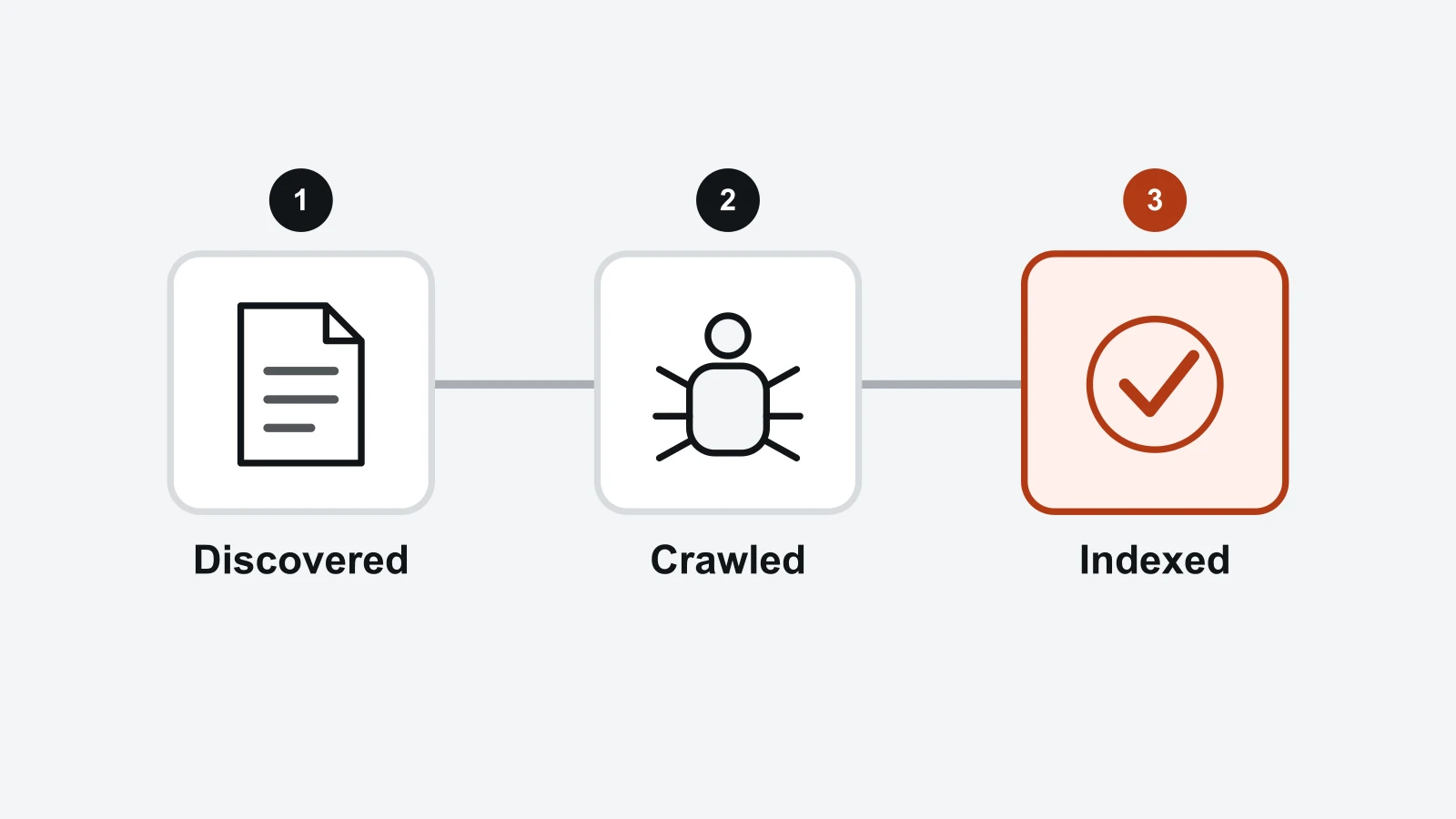
On this page 10 sections
- How to check if a page is indexed by Google
- Why Google indexes a page and then drops it a week later
- Is Google deindexing more pages in 2026?
- What each Search Console index verdict actually means
- How to find out when a page was first indexed
- Crawling and indexing are not the same thing
- How to get a page indexed
- How to check indexed pages across a whole site
- Indexing decides AI visibility too
- Choose the product URLs worth inspecting first
Short answer: To check whether Google has indexed a page, use the URL Inspection tool in Search Console, which reads Google's own index. The site: operator is a rough smoke test on a single full URL, and Google states it will not return every indexed URL. Search Console does not publish the date a page was first indexed.
How to check if a page is indexed by Google
Three methods exist, and the gap between the best and the worst is wider than most guides admit. Only one of them reads Google's index directly. Ranked by what each actually looks at:
Method | What it tells you | Trust it for |
|---|---|---|
URL Inspection (Search Console) | The current index verdict for one URL, read from Google's index, plus the last crawl date and the canonical Google chose | The real answer on a single page |
Page indexing report (Search Console) | Aggregated counts of indexed and not indexed pages across the site, grouped by reason | Site-wide patterns, with a lag of days |
| An incomplete, unranked sample of what Google will show for a prefix | A rough smoke test on one full URL, never a count |
Most guides to this question lead with site: and tell you to count the results. Google's own documentation says not to. The `site:` operator page (opens in a new tab), last updated in December 2025, states that the operator does not necessarily return all the URLs that are indexed under the prefix in the query.
Google adds two qualifications on the same page. The first is to keep that incompleteness in mind if you want to use site: for tasks like identifying how many URLs are indexed. The second is that a site: query with no search terms does not rank its results at all: Google says it generally shows the shortest URL first and the rest are relatively random. A count taken from an unranked, incomplete sample is not a measurement.
The same page is more forgiving about the narrow case. Under its uses for site owners, Google says that a site: query on one complete URL may help you understand whether a specific URL is indexed and served. That is the honest boundary. Use site:https://example.com/exact-page as a two-second sanity check on one page, and never use site:example.com as a page count.
Why Google indexes a page and then drops it a week later
Because indexing is not a permanent state. Google reassesses, and a page that was indexed on Monday can be out of the index by the following Monday with nothing about the page having changed. This is the single most common confusion around index checking, and it has a straightforward answer: an index check is a reading with a timestamp, not a fact about the page.
Before concluding that Google dropped a page, run four checks on it, because each one rules out a cause that has nothing to do with an index decision:
- Fetch the page by hand and confirm it returns HTTP 200.
- Confirm it carries no
noindexdirective. - Check whether anything in the window changed the rendered content, rather than only the code around it.
- Re-read the verdict a few days later, because a page that comes straight back was a flicker rather than a decision.
Exclude redirects before you count anything. A legacy URL that redirects, such as an old trailing-slash address after a migration, can appear to leave the index one day and return the next, and that reading reflects redirect handling rather than an index decision. When a live page passes all four checks and stays out, Google has made a quality judgement, and the verdict table below says what each one means.
Is Google deindexing more pages in 2026?
Nobody can answer that with confidence yet, and the disagreement is the interesting part. Since the start of April 2026, large numbers of SEOs have reported pages leaving Google's index at unusual rates. Google's position is that nothing exceptional is happening.
John Mueller, posting on Bluesky on 30 April 2026, said "I don't see anything exceptional there", adding that some sites go up and some go down.
A second explanation came from the SEO community rather than from Google. Valentin Pletzer, checking reported URLs by hand and finding them present in the index, asked whether the reports might be a Search Console reporting bug rather than real removal.
That is a fair question, and a site owner can answer it for their own pages. Read the verdicts through the URL Inspection API, on URLs independently confirmed as live, returning 200 and carrying no noindex. A reporting artefact would have to survive that check. It does not settle the wider argument, and it makes your own readings cleaner than most of what is being reported.
There is a documented precedent and its date matters. Indexing Insight found that across 2 million monitored pages, 25 per cent were actively removed from Google's index, with individual sites losing between 15 and 75 per cent of theirs. That measurement describes an event at the end of May 2025, not 2026, and it is widely re-quoted without that date attached.
A separate review of around 40 sites over the same 2025 period found the removed pages were mostly ones Google would be unlikely to serve to anyone.
What each Search Console index verdict actually means
The Page indexing report groups unindexed pages by reason, and the reasons are not equally worrying. Google documents each one, and the two people worry about most are the two Google explicitly says need no action.
- Indexed
The inspected page is currently reported in the index.
- Not indexed
Inspect the specific exclusion reason.
- Unknown
The available evidence does not establish the state.
Use the actual inspection result rather than treating every absence as the same failure.
Verdict | What Google says it means | Does it need fixing? |
|---|---|---|
Crawled, currently not indexed | The page was crawled by Google but not indexed. It may or may not be indexed in the future; no need to resubmit this URL for crawling | Not directly. It is a quality judgement, so the fix is the page, not the request |
Discovered, currently not indexed | The page was found by Google, but not crawled yet. Typically Google wanted to crawl the URL but this was expected to overload the site, so the crawl was rescheduled | Check server response times and crawl budget |
Duplicate without user-selected canonical | The page is a duplicate of another page and does not indicate a preferred canonical. Google has chosen the other page and will not serve this one | Optional. Set a canonical, or make the pages genuinely different |
Alternate page with proper canonical tag | The page is marked as an alternate of another page, that is, an AMP page with a desktop canonical or a mobile version of a desktop canonical. It correctly points to the canonical page, which is indexed, so there is nothing you need to do | No. Working as intended |
Read the first row carefully, because it is the one that generates the most wasted effort. Crawled, currently not indexed is not an error. Google reached the page, looked at it, and decided not to store it. Resubmitting it through Request Indexing does not change the judgement, which is why Google's own text tells you not to bother. The page has to become more worth indexing, or it stays out.
How to find out when a page was first indexed
Honestly: you mostly cannot, and every widely-repeated trick for it has decayed. Google Search Console does not expose the date a page was first indexed. URL Inspection gives you the last crawl date, not the first index date, and the Page indexing report shows counts over time rather than per-URL history.
The advice circulating for this question is mostly a decade old. The most-repeated version tells you to narrow results with the Search Tools date filter and read the date off what appears. That was never reliable: it reflects when Google will show a result for a date range, not when Google indexed the page.
A second version points at the About this result panel, and it is a category error. The month and year that panel reports is when Google first indexed the site, not the page, so it cannot answer a page-level question however carefully you read it. It also stops resolving at ten years, reporting anything older as more than ten years ago, and it surfaces only where Google has no Wikipedia description to show instead.
The workable answer is to stop recovering history and start recording it. An index verdict is cheap to capture and only meaningful as a series, so the useful artefact is a per-URL index status history: the verdict for every page, captured on a schedule, with each transition dated.
A recorded series shows a page leaving the index in the week it happens, rather than months later when a traffic line has bent. Without one, the first you hear of a page leaving Google's index is when somebody asks why it stopped converting. Deindexing is one of five causes worth ruling out when positions fall, and diagnosing a Google rankings drop sets out the other four in the order to check them.
From RankX AIInvestigate the product page that should be found.For an important page that is not indexed, check access, visible product usefulness and links from the category before requesting another crawl.Explore website auditsCrawling and indexing are not the same thing
The difference is what Google does with the page after it arrives. Crawling is Google fetching the page. Indexing is Google deciding to keep it in the Google index. All search engines separate the two steps, they fail separately, they are diagnosed separately, and conflating them sends people to fix the wrong thing.
- Discover
Google learns the URL exists.
- Crawl
Google fetches the resource.
- Index
Google decides whether to store it for search.
A crawler visit does not prove that the page entered the index.
- Not crawled means Googlebot never fetched the URL. Causes live in robots.txt, server errors, redirect chains, or a page nothing links to. Look at the fetch status.
- Crawled but not indexed means the fetch worked and the judgement went against you. Nothing in your server configuration will fix it.
- Indexed but not ranking means you passed both tests and lost on relevance or competition. That is a content and authority problem, not an indexing one.
A useful consequence: blocking a URL in robots.txt does not remove it from the index. It prevents crawling, and a page Google cannot crawl is a page whose noindex Google can never read. To remove a page from the index, allow the crawl and serve noindex, then keep the crawl allowed until the removal registers.
How to get a page indexed
The mechanics are unglamorous and there is no lever that forces the decision. In rough order of how much they actually move things:
- Link to it from a page that is already indexed and crawled often. Internal links are the strongest discovery route you control, and a page with no inbound internal links is close to invisible whatever its quality.
- Include it in your XML sitemap with an honest
lastmod. A sitemap is a discovery aid, not an instruction, and it guarantees nothing. - Use Request Indexing in Search Console for a genuinely new or genuinely changed page. It queues a crawl, it does not buy an indexing decision, and using it repeatedly on the same URL achieves nothing.
- Make the page worth indexing. For anything sitting in crawled, currently not indexed, this is the only step that matters.
Two shortcuts get recommended constantly and neither does what people think. Google's Indexing API (opens in a new tab) is documented as usable only to crawl pages with either JobPosting or BroadcastEvent embedded in a VideoObject, so it is not a route for ordinary pages, and its onboarding quota is 200 queries a day.
That restriction is worth dwelling on, because the page currently ranking best for this question disputes it. CrawlWP acknowledges Google's official position and then tells readers the API works for any content type regardless, while selling a WordPress plugin from 59 dollars a year that submits ordinary URLs through it.
Google's wording is that the API can only be used for those two types. Whatever the endpoint accepts today, sending it content it is not documented to serve is a risk you are choosing rather than a technique you have found, and the party who decides how that ends is Google.
IndexNow is a genuine push protocol with real adoption, but its own FAQ lists the participants as Amazon, Bing, Naver, Seznam.cz, Yandex and Yep. Google is absent, and has been since it said it would evaluate the protocol in late 2021. Implement IndexNow for Bing if Bing matters to you, and expect nothing from it in Google.
How to check indexed pages across a whole site
Checking one URL by hand does not scale past about 20 pages. The Search Console URL Inspection API returns the same verdict as the tool, programmatically, and its published quotas (opens in a new tab) are the thing to plan around. The daily ceiling is the one that binds; at 600 queries a minute, the rate limit almost never does.
Limit | Per site | Per project |
|---|---|---|
Queries per day | 2,000 | 10,000,000 |
Queries per minute | 600 | 15,000 |
The per-site figure is per verified property, not per account, which is the detail that decides how you shard the work. At 2,000 queries a day, a site of 10,000 pages takes five days for one full sweep.
So most people sample rather than sweep: inspect the pages that earn money daily, and rotate the long tail weekly. Whatever runs the sweep, store each verdict with the date you read it. Search Console shows you today's answer and not last week's, so a week-on-week comparison only exists if something kept both readings. RankX AI does that on a schedule, and the index coverage docs describe what it reads and how often.
One free shortcut narrows the list before you spend a single quota unit. A page earning impressions in the Performance report is a page Google has indexed, so anything with impressions can be skipped. That leaves the silent pages to inspect, and reading impressions with no clicks explains what the remaining numbers do and do not prove.
Indexing decides AI visibility too
Being indexed is no longer only about blue links, and this is the part most indexing guides miss entirely. Google's AI Overviews and AI Mode draw on Google's index: a page must be indexed and eligible to be shown with a snippet to be cited in either. A noindex directive therefore removes a page from AI Overviews as surely as it removes it from search results, and restrictive snippet controls cap what those features may quote from you.
It also cuts the other way, which surprises people. Google's crawler documentation states that Google-Extended does not impact a site's inclusion in Google Search nor is it used as a ranking signal in Google Search. Blocking it opts you out of Gemini training and grounding and leaves AI Overviews untouched. Those are separate controls for separate systems, and blocking the wrong one is a self-inflicted wound.
Beyond Google, the assistants run indexes of their own. OAI-SearchBot builds the index behind ChatGPT search, Claude-SearchBot does the same for Claude, and PerplexityBot for Perplexity. Each holds its own view of your site with its own inclusion decision, and none of them reports into Search Console.
Bing runs the other index worth checking, because Microsoft grounds Copilot on it and Bing applies a selection step Google does not describe in the same terms. A site Google indexes freely can still be largely absent from Bing, and Bing indexing and the inbound links warning covers how to read that gap.
The practical position is that Search Console answers one indexing question and there are several. Whether the AI crawlers can reach you at all is a separate check, which our AI crawler access checker answers, and how AI crawlers read your site covers what they do once they arrive.
Choose the product URLs worth inspecting first
Start with an important category, a saleable product and any variant URL that receives separate search demand. Record the exact URL, inspection date, declared canonical and Google-selected canonical. A variant consolidated into the intended parent may be working as designed; do not count every excluded variant as an SEO failure.
For an important page that is not indexed, check access, visible product usefulness and links from the category before requesting another crawl. Keep the inspection record so later checks can distinguish a newly observed indexed state from the unknown date of first inclusion. Submitted sitemaps and discovery requests do not guarantee selection. Track the page that should serve the query rather than trying to index every filter combination.
Next, diagnose a catalogue ranking loss or review topic ownership.
Questions about Ecommerce & Technical SEO
How long does Google take to index a new page?
Google's own documentation gives one range and it is narrower than most articles claim: crawling can take anywhere from a few days to a few weeks. Be sceptical of anything more precise. The averages published around this question, the ones quoting a specific number of days for new sites or for e-commerce pages, are generally unattributed and not reproducible, so treat them as folklore rather than measurement. The variable that moves it most is whether Google has a reason to come back, and no setting in Search Console exposes that.
What does it mean when Google has indexed a page?
It means Google has fetched the page, processed it, and stored it in the Google index so it is eligible to appear in search results. Search engines keep only a fraction of the web pages they crawl, so this is a decision rather than a formality. Eligible is not the same as ranking: an indexed page can sit in the index for months without being shown for anything, because indexing decides whether you can appear and ranking decides whether you do. It also means the page can be quoted in AI Overviews and AI Mode, which draw only on indexed, snippet-eligible pages.
Why does the URL Inspection tool disagree with the Page indexing report?
Because they are different data paths with different refresh cycles. URL Inspection queries the live index for one URL at the moment you ask. The Page indexing report is an aggregated view that lags, typically by days. When they disagree, the URL Inspection verdict is the more current one for that single URL. That gap is worth knowing during the 2026 deindexing reports, because some observers have suggested those reports may partly reflect a Search Console reporting problem. Whatever the answer, inspecting a handful of the affected URLs directly is the check that does not depend on the aggregate being right.
Can I use Google's Indexing API to get my pages indexed faster?
Almost certainly not. Google's documentation states that the Indexing API can only be used to crawl pages with either JobPosting or BroadcastEvent embedded in a VideoObject. It is not for blog posts, product pages or ordinary web content, and the default quota for onboarding and testing is 200 calls. Services that offer to push arbitrary URLs through it are using it outside its documented purpose. For everything else, the tool Google intends you to use is Request Indexing in Search Console.
Does IndexNow work for Google?
No. IndexNow is an open push protocol created by Microsoft and Yandex, and the participants listed on its own FAQ are Amazon, Bing, Naver, Seznam.cz, Yandex and Yep. Google is not among them. Google said in late 2021 that it would evaluate the protocol and has never adopted it for general web indexing. IndexNow is still worth implementing if Bing and the other listed engines matter to you, and it costs almost nothing to add, but it will not affect how quickly Google finds your pages.
Does submitting a sitemap guarantee that Google will index a page?
No. A sitemap is a discovery aid, not an instruction. It tells Google which URLs exist and when they last changed significantly, which helps Google find pages that internal linking alone might not reach. It creates no obligation to crawl or index any of them. A page that is in your sitemap and still not indexed has usually failed on a different test, most often that Google fetched it and judged it not worth storing, which Search Console reports as crawled, currently not indexed.
Is it a problem if some pages are not indexed?
Often not. Google's own guidance on crawled, currently not indexed says the page may or may not be indexed in future and that there is no need to resubmit the URL. Plenty of pages should not be indexed at all: paginated archives, filtered views, thin utility pages and anything you have deliberately marked noindex. The question worth asking is not how many pages are unindexed but whether the unindexed ones are pages you actually needed in search. A missing product page matters, a missing tag archive does not.
Sources
- Google Search Central, `site:` search operator, last updated 10 December 2025. Exact wording: 'The site: operator was designed primarily for search users and so it has some restrictions that site owners might find limiting'; 'The site: operator doesn't necessarily return all the URLs that are indexed under the prefix specified in the query. Keep this in mind if you want to use the site: operator for tasks like identifying how many URLs are indexed and serving under a prefix'; and 'A site: operator without a query (for example site:example.com) doesn't rank the results. It will generally show the shortest URL for the prefix at the top, but otherwise the results are relatively random'. The same page's 'Uses for site owners' table gives site:https://example.com/recipes/tsukemen.html as 'May help you understand whether a specific URL is indexed and served' (opens in a new tab) Checked 2026-09-10.
- Google Search Console Help, Page indexing report: the four verdict definitions. 'Crawled - currently not indexed': 'The page was crawled by Google but not indexed. It may or may not be indexed in the future; no need to resubmit this URL for crawling'. 'Discovered - currently not indexed': 'The page was found by Google, but not crawled yet. Typically, Google wanted to crawl the URL but this was expected to overload the site; therefore Google rescheduled the crawl'. 'Duplicate without user-selected canonical': 'This page is a duplicate of another page, although it doesn't indicate a preferred canonical page. Google has chosen the other page as the canonical for this page, and so will not serve this page in Search'. 'Alternate page with proper canonical tag': 'This page correctly points to the canonical page, which is indexed, so there is nothing you need to do' (opens in a new tab) Checked 2026-09-10.
- Google Search Console API, Usage limits: URL Inspection API per-site '2000 QPD' and '600 QPM'; per-project '10,000,000 QPD' and '15,000 QPM'. The 2,000 daily ceiling applies to each verified property rather than to the account, so multiple properties each carry their own allowance (opens in a new tab) Checked 2026-09-10.
- Google, Indexing API quickstart: 'The Indexing API can only be used to crawl pages with either JobPosting or BroadcastEvent embedded in a VideoObject'. Also the default onboarding and testing quota of 200 calls. (opens in a new tab) Checked 2026-09-10.
- IndexNow official FAQ, participating search engines: Amazon, Bing, Naver, Seznam.cz, Yandex and Yep. Google is not listed (opens in a new tab) Checked 2026-09-10.
- Google Search Central, Google crawlers and user-triggered fetchers: 'Google-Extended does not impact a site's inclusion in Google Search nor is it used as a ranking signal in Google Search'. Also confirms the products it governs: Gemini Apps, the Vertex AI API for Gemini, and grounding in both (opens in a new tab) Checked 2026-09-10.
- Indexing Insight, Google Indexing Purge study: across 2 million monitored pages, 25 per cent were actively removed from Google's index, with individual sites seeing between 15 and 75 per cent of monitored pages move out. The event described is the end of May 2025; the study was published 25 February 2026 and gives no methodology detail on monitoring duration before the event (opens in a new tab) Checked 2026-09-10.
- Search Engine Roundtable, 1 May 2026, on the elevated deindexing reports. John Mueller on Bluesky, 30 April 2026 06:15: 'Some sites go up, some sites go down - I don't see anything exceptional there.' The report dates the start of the reports to around the beginning of April 2026, via Pedro Dias (opens in a new tab) Checked 2026-09-10.
- Valentin Pletzer's reporting-bug question, recorded in the Search Engine Roundtable thread above and corroborated by PPC Land's and McCrossen Marketing's independent write-ups of the same episode. Pletzer, an independent SEO, checked reported URLs by hand, found them present in the index, and asked 'I wonder if there is some kind of reporting bug?' (opens in a new tab) Checked 2026-09-10.
- Google Search Central, Ask Google to Recrawl Your Website: 'Crawling can take anywhere from a few days to a few weeks.' The page does not mention months (opens in a new tab) Checked 2026-09-10.
- CrawlWP, 'How Long Before Google Index a New Website & Page?', last updated 4 March 2026, read 10 September 2026. It acknowledges Google's restriction and then states that the Indexing API 'works for any content type, and many site owners use it successfully for blogs, e-commerce products, and standard pages', alongside a WordPress plugin priced from 59 dollars a year that submits ordinary URLs through it. Google's quickstart above says the API 'can only be used' for JobPosting and BroadcastEvent pages. Its indexing-speed figures, including 24 to 72 hours for established sites and 2 to 4 weeks for new ones, are unattributed (opens in a new tab) Checked 2026-09-10.
- Marie Haynes, analysis of pages Google began deindexing in late May 2025: across roughly 40 sites reviewed, drops clustered around 27 May 2025 and the pages being removed were predominantly ones Google would be unlikely to serve to searchers (opens in a new tab) Checked 2026-09-10.
- Google Search Central: ecommerce site structure (opens in a new tab) Checked 20 Oct 2026.
Asif Syed is the founder and CEO of RankX AI, the AI search visibility platform. He builds the product and writes here about GEO, AI search measurement and WordPress.
CoversThis article covers the Ecommerce & Technical SEO topic, the Website Audit feature and the AI Crawler Access Checker tool.
Terms usedXML Sitemap, Robots.txt, Canonical Tag, Crawl Budget, SERP, AI Overview, Google AI Mode, AI Crawler, OAI-SearchBot, PerplexityBot, Grounding and Schema Markup (Structured Data).
Read this page asMarkdown: /blog/check-when-google-indexed-page.md.
All articlesEverything RankX AI publishes is listed on the blog index.
Ask an assistantAsk ChatGPT (opens in a new tab), Ask Claude (opens in a new tab) or Ask Perplexity (opens in a new tab).
Preferred sourceIf Google is your front door, you can add RankX AI as a preferred source (opens in a new tab), which asks your own results to surface more of what we publish.