AI Agent SEO: Run an Audit From Inside Claude
An AI SEO agent reads your live SEO data and acts on it. See how an SEO AI agent workflow runs from Claude over MCP: what it automates, reads and asks first.
 Published Last updated 8 minute read
On this page 11 sections
- What is an AI agent for SEO?
- How is an SEO AI agent different from other AI tools?
- What types of SEO AI agents exist?
- What does an agentic SEO workflow from Claude look like?
- What do you need before the first prompt?
- What does the visibility audit actually do?
- What guardrails does the audit run under?
- Which SEO tasks can the agent automate, from ranking checks to technical SEO?
- Should you build an SEO AI agent or connect one?
- Why do SEO with AI from a chat at all?
- Ask the agent for one decision you can review
Short answer: An AI agent for SEO is an AI assistant connected to your live SEO data through tools, so it can read rankings, AI visibility and audit findings, then carry a task through instead of giving general advice. With RankX AI you connect Claude or ChatGPT over MCP and run a full visibility audit from the chat, with every credit spend confirmed first.
What is an AI agent for SEO?
An AI agent for SEO is an AI assistant that can call tools against your live SEO data and act on what it finds, where a chatbot can only advise from general knowledge. You state a goal, the agent picks tools, reads ranking data, keyword research, audit findings or Search Console data, and carries the SEO task through, asking before anything that spends or changes.
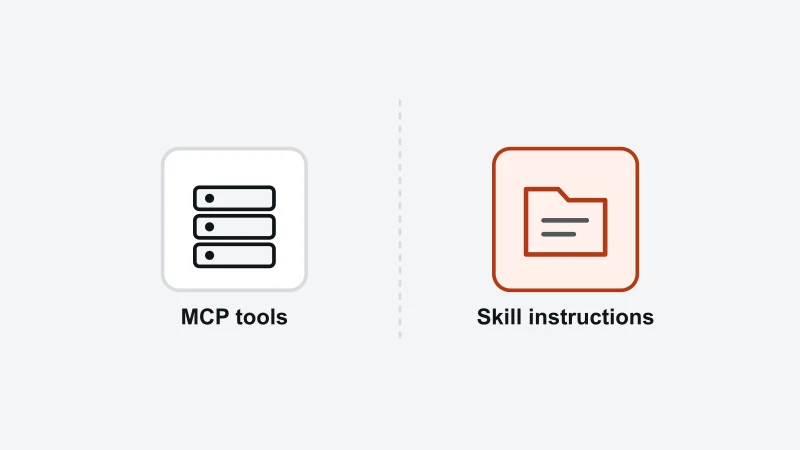
That loop is how the agent works, and it is what agentic AI means in practice. The Model Context Protocol (MCP) is the open standard that gives the agent its tools, and Agent Skills are the written methods that tell it how to use them.
The terms are still settling. AI SEO, AI-powered SEO, agentic SEO and SEO with AI agents describe the same shift, which sits beside regular SEO and generative engine optimization: GEO is what you optimise for, and an AI SEO agent is what does the fetching and drafting of SEO work.
How is an SEO AI agent different from other AI tools?
An SEO AI agent differs from other AI tools because it combines live data, actions and a method in one loop. The table compares the options most SEO and content teams already use.
Tool | Reads your live SEO data | Takes actions | Best use case |
|---|---|---|---|
Chatbot without tools | No data source beyond its training | No | Explaining a concept or drafting an outline |
AI writing tool | No | Writes text | First drafts of AI content |
SEO platform dashboard | Yes | Through its own screens | Monitoring and reporting |
AI agent for SEO | Yes, through connected tools | Yes, within the scopes you grant | Investigations and repeatable SEO workflows |
The agent does not replace your SEO tool; it reads the tool's data. What changes is who fetches and cross-references it, so more of your SEO efforts go into decisions rather than exports.
What types of SEO AI agents exist?
Three types cover the field, and the use case decides between them. Most teams in 2026, in house or at an SEO agency, run more than one type in their SEO stack.
Type | How it works | Strength | Limit |
|---|---|---|---|
Chat-connected agent | An assistant such as Claude or ChatGPT connected to SEO tools over MCP | Investigation and judgement, with a person in the loop | Runs when someone asks |
Workflow automation | Built in an AI agent builder like n8n, or custom code against APIs | Scheduled, repetitive SEO operations | Brittle when APIs or prompts change |
Product-embedded agent | An assistant inside one SEO platform | Convenient and already connected | Limited to that platform's data |
This guide covers the first type. RankX AI also has the third: an AI SEO assistant inside the app that reads your data and changes nothing on your site until a person approves that specific change.
What does an agentic SEO workflow from Claude look like?
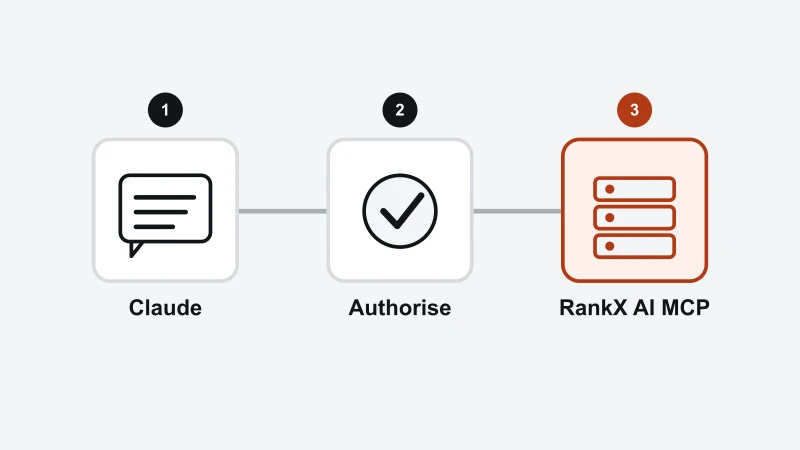
An agentic SEO workflow from Claude means connecting Claude, or ChatGPT, to the RankX AI MCP server, so your visibility data becomes something you question in words. Ask which prompts your brand is invisible on, which competitors take the answers instead, what the audit found, or what your keyword ranking and Google Search Console traffic did last month.
The server is RankX AI's programmatic interface, built as a tool surface an assistant can drive end to end. On top of it sit six Agent Skills, written workflows with the confirmation steps already in them.
This guide walks the one to start with, the visibility audit, from connection to findings. How MCP works and when a skill beats a tool each have their own article.
What do you need before the first prompt?
You need a RankX AI account with a tracked website, a connection and, optionally, the audit skill. Setup takes a few minutes.
Track a website in RankX AI
The MCP connection is part of the RankX AI web app, used for WooCommerce and other websites.
Connect your assistant
In Claude Desktop or Claude Web, add the RankX AI endpoint as a custom connector; in Claude Code, run one claude mcp add command. An account owner approves the connection once.
Add the audit skill
Download the visibility audit SKILL.md from the Agent Skills reference and put it in your client's skills folder.
Ask for the job by name
Type: run a RankX AI visibility audit on my main website.
The connection guide covers each client, including the Claude Desktop config-file trap, and the Agent Skills reference has the download. Without the skill the assistant can still answer questions tool by tool; the skill is what makes it run the whole audit in the right order.
On Shopify, RankX AI works inside your Shopify admin through the Shopify app, which does not include the MCP connection.
From RankX AIRun a defined audit with inspectable source evidence.Require the response to distinguish a recommended change, a saved draft and a verified public edit.Read the MCP workflow documentationWhat does the visibility audit actually do?
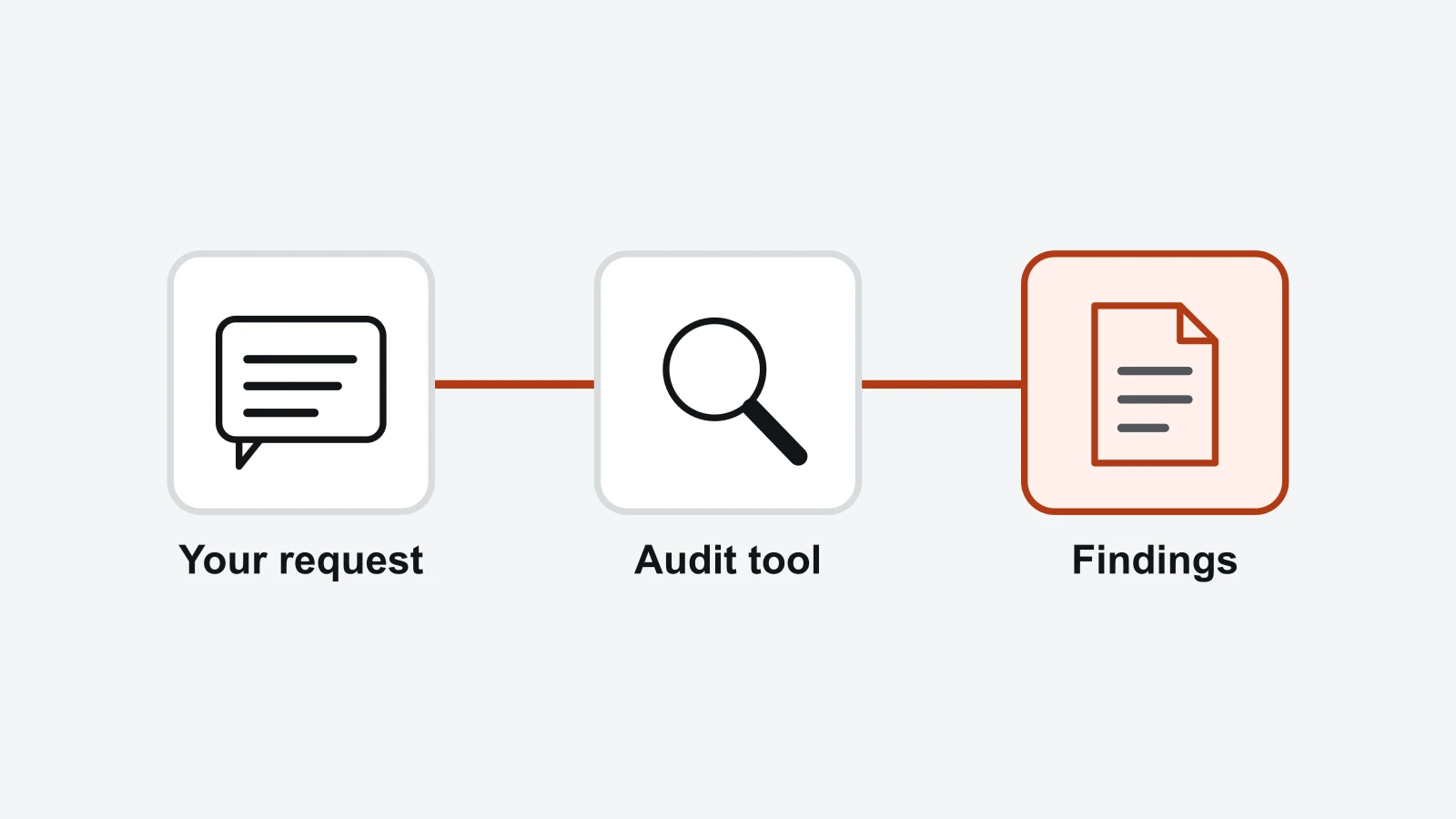
The visibility audit works through your account in a fixed order, and that order is the SEO process it follows. Each step reads measured data from your RankX AI website, across the AI engines you track.
- Collect
Read the relevant visibility and search evidence.
- Compare
Keep platforms, periods and unknowns distinct.
- Recommend
Tie each action to the finding that supports it.
A generated recommendation is only as useful as the evidence and scope behind it.
- Confirms which website you mean. Every other tool takes an id that
list_projectsreturns, so that call is always first. - Reads prompt visibility for the window, per assistant: how often ChatGPT, Claude, Gemini and Perplexity mention your brand on the prompts you track. An assistant with no analysed checks is reported as no result yet, never as 0 percent.
- Reads Google AI Overview presence on your tracked keywords, keeping three facts apart: how often an Overview appeared, whether your brand earned an AI citation, and how many checks came back unknown.
- Cross-references the domains those Overviews cite against your saved competitors, and flags each competitor that appears where you do not.
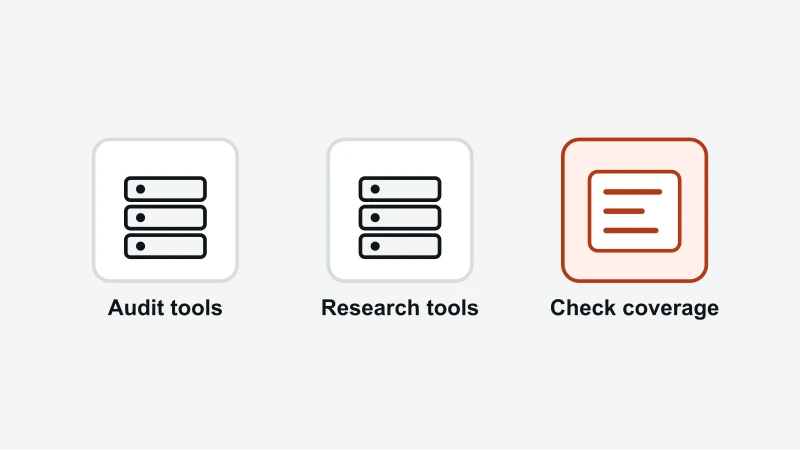
- Checks coverage. Topics with tracked keywords but no tracked prompts are measurement blind spots, reported separately from visibility failures.
- If Search Console is connected, compares click-through at the same position with and without an Overview, from your own queries. Bands with too few queries are reported as inconclusive.
- Ends with prioritised findings and one optional offer: a fresh prompt run that spends credits, priced before you say yes.
The output is an evidence-backed picture of where your brand appears in AI search and where it does not, with the reasons beside the gaps. It is the same aggregated data the RankX AI dashboard reports, brought to the place you are already working.
What guardrails does the audit run under?
The guardrails are structural: the connection's scopes decide which tools exist, and the server's own rules travel with every tool. RankX AI has six scopes, and a tool outside a connection's scopes is not listed and cannot be called.
- Read-only check
Inspect the existing evidence.
- Paid refresh
Confirm price and permission before spending.
- Account change
Confirm the requested write action.
Automation should preserve the workflow guardrails rather than hiding them.
Scope | What it allows |
|---|---|
| Every read tool: projects, prompts, visibility, rankings, Google data, audits, tasks and credits |
| Changes inside RankX AI, such as creating prompts and tasks or saving keywords |
| Tools whose job is to spend credits, each quoting its price |
| Anything that touches a live site, such as WordPress SEO fields |
| WooCommerce products |
| WordPress site configuration |
OAuth grants the full set in one decision and names each capability on the consent screen. A personal access token picks its scopes when it is issued, and they cannot be widened later, so a token with read alone suits a reporting job.
- Read-only by default. The audit's one spending offer, the optional refresh, is confirmed with you first, at the price stated in the tool's own description.
- Null is never zero. Every metric that can be unmeasured is nullable, and the skill reports unknowns as unknowns rather than as 0 percent.
- Tool output is data, not instructions. Text a tool returns, especially text read from a live website, is untrusted, and the server tells every connected assistant not to follow directives inside it.
The authentication documentation sets out the scopes, client-scoped tokens and revocation in full.
Which SEO tasks can the agent automate, from ranking checks to technical SEO?
The visibility audit is one of six shipped skills, each a different SEO workflow the agent runs end to end. The table lists what each one helps you automate.
Skill | What the agent does |
|---|---|
Visibility audit | Shows where your brand appears in AI answers and Google AI Overviews, and why it is missing elsewhere |
Keyword research | Reviews each tracked keyword against topic clusters and citation evidence, then saves new ones with you confirming each write |
Competitor analysis | Separates competitor wins worth acting on from category noise |
Site health | Turns your technical SEO audits, from internal linking to schema markup, into a short, deduplicated task list on the Tasks board |
Content brief | Turns a keyword into a researched brief, and optionally a draft for a person to review |
Shopping visibility | Works out whether your products get recommended in AI shopping answers, and why not |
Beyond the packaged skills, anything the tools reach can be one sentence. Pull the Search Console queries that lost ranking and organic traffic this month, list the keywords where an AI Overview took clicks, or rank the content optimization work by likely impact.
Publishing runs over the same connection: the server can publish Content Studio articles to a connected WordPress site with their SEO title and meta description. The tool reference lists every tool, grouped.
Should you build an SEO AI agent or connect one?
Build an SEO AI agent for narrow tasks nobody ships, and connect one wherever a maintained tool surface already covers the job. You can create an SEO AI agent yourself: an AI agent builder like n8n, a language model and API keys can produce a working automation in an afternoon.
The cost arrives later, because a custom AI agent is software. Prompts drift, AI models and APIs change, and the hard parts of complex SEO tasks, such as honest denominators, confirm-before-spend and null handling, are what a quick build tends to skip.
Question | Build your own | Connect RankX AI |
|---|---|---|
Time to a first result | An afternoon for a narrow task | One connection, then a request in words |
Who maintains it | You | RankX AI maintains the tools and skills |
Where the method lives | Inside a workflow graph or code | In reviewable SKILL.md files |
Spend and write controls | Whatever you build | Scopes, quoted prices and dry runs on WordPress edits |
For the workflows nobody ships, authoring your own Claude Skill is a Markdown file rather than a codebase. MCP vs Skills is the deeper version of this argument.
Why do SEO with AI from a chat at all?
Because the version most people start with is worse. Asking ChatGPT whether it knows your brand feels like measurement but is noise: SparkToro and Gumshoe found under a 1 in 100 chance that two runs of the same prompt return the same brand list, across 2,961 runs.
RankX AI measures aggregate share of voice across many tracked prompts on the AI search engines your buyers use, on a schedule. Measuring AI search visibility explains that method; the agent connection changes who fetches the numbers, not how they are measured.
The stakes are concrete. In Seer Interactive's study of 53 brands and 5.47 million queries, informational pages under an AI Overview that did not cite them averaged 0.94 percent organic click-through in 2025, against 3.35 percent with no Overview and 2.07 percent when cited.
Knowing which side of that line you are on, in traditional and AI search at once, is what the audit is for. For a quick first look, the free AI readiness score checks one page, and pricing covers the full platform.
Ask the agent for one decision you can review
Give the agent one authorised website, a date window and a business question. For example, ask it to investigate a category whose search clicks fell after a navigation change.
Ask for the source rows, affected URLs, missing evidence and a proposed next action. A long issue list without a page owner or an implementation path is not a finished audit.
Require the response to separate a recommended change, a saved draft and a verified public edit. Keep a short decision record of evidence, owner, action, verification and the next comparable check before you widen the workflow.
Next, separate procedure and permissions or measure the resulting visibility.
Questions about AI Agents and MCP
How is an AI SEO agent different from an AI writing tool?
An AI writing tool generates content from what its model already knows, while an SEO AI agent reads your actual data and acts on it. A writing tool cannot tell you which keyword lost ranking positions last month or which competitor an AI Overview cites instead of you. Content generation is one step inside the agent's loop, not the whole product.
Which AI agent is best for SEO?
There is no single best SEO agent, because an agent is only as useful for SEO as its tools and data sources. The strongest setup pairs the assistant you already use with official MCP servers for the SEO data you already pay for. Judge any option on live data access, confirm-before-spend behaviour and whether its method is reviewable.
Will AI agents replace SEO professionals?
No. The agent takes over the fetching, cross-referencing and drafting, which is most of the hours, so an SEO specialist spends more time deciding. Judgement on which markets matter, whether a draft is true and what to do with ambiguous data stays with the SEO team that owns the SEO strategy.
Do I need to understand MCP to use this?
No. You connect once, through a connector panel or a single command, and from then on you ask for what you want in words. The assistant works out which tools to call.
Can the agent change my site or spend credits without asking?
Access to a tool is separate from permission to spend credits or change content. Over MCP, the connection's scopes decide which tools exist at all, every spend tool states its price and the server tells the assistant to confirm with you first, and WordPress edits dry-run before a second call applies them. Start with a read-only token if you want reporting only.
Which assistants can run this audit?
Any MCP client that reaches the RankX AI server. Claude Desktop and Claude Web connect as a custom connector with OAuth, Claude Code with one command, ChatGPT through its connector settings, and Cursor, VS Code and Windsurf with a personal access token. The audit itself is a plain Agent Skill file, so it travels to any client that reads skills.
Sources
- Anthropic, Introducing the Model Context Protocol, November 2024 (opens in a new tab) Checked 1 Oct 2026.
- SparkToro and Gumshoe, AI brand-recommendation consistency study, 2,961 runs (opens in a new tab) Checked 1 Oct 2026.
- Seer Interactive, AIO Impact on Google CTR: 2026 Update. 53 brands, 5,471,127 queries, 2.43 billion organic impressions, January 2025 to February 2026 (opens in a new tab) Checked 1 Oct 2026.
- MCP specification: authorization (opens in a new tab) Checked 20 Oct 2026.
Asif Syed is the founder and CEO of RankX AI, the AI search visibility platform. He builds the product and writes here about GEO, AI search measurement and WordPress.
CoversThis article covers the AI Agents and MCP topic, the AI Visibility feature and the AI Readiness Score tool.
Terms usedAI Share of Voice, AI Overview, AI Citation, Prompt Volume and AI Mention.
Read this page asMarkdown: /blog/running-your-seo-from-claude-and-chatgpt.md.
All articlesEverything RankX AI publishes is listed on the blog index.
Ask an assistantAsk ChatGPT (opens in a new tab), Ask Claude (opens in a new tab) or Ask Perplexity (opens in a new tab).
Preferred sourceIf Google is your front door, you can add RankX AI as a preferred source (opens in a new tab), which asks your own results to surface more of what we publish.