MCP vs Skills: When to Use Which
MCP gives an assistant access to your systems; a skill teaches it your procedure. When each is the right tool, from a team that ships and maintains both.
 Published Last updated 6 minute read
On this page 8 sections
- Skills vs MCP: what is the key difference?
- What does a Model Context Protocol server do?
- How do skills add domain expertise?
- When should you use MCP for external data?
- When should you use skills?
- How do you decide between MCP and a skill?
- How do MCP and skills work together?
- Decide what a product-copy workflow is missing
Short answer: MCP and skills solve different problems. An MCP server gives an AI assistant access, tools it can call against a live system behind authentication and permissions, while a skill gives it procedure: written instructions for doing a job well. If the assistant cannot reach your data, add MCP; if it reaches the data but works sloppily, add a skill.
Skills vs MCP: what is the key difference?
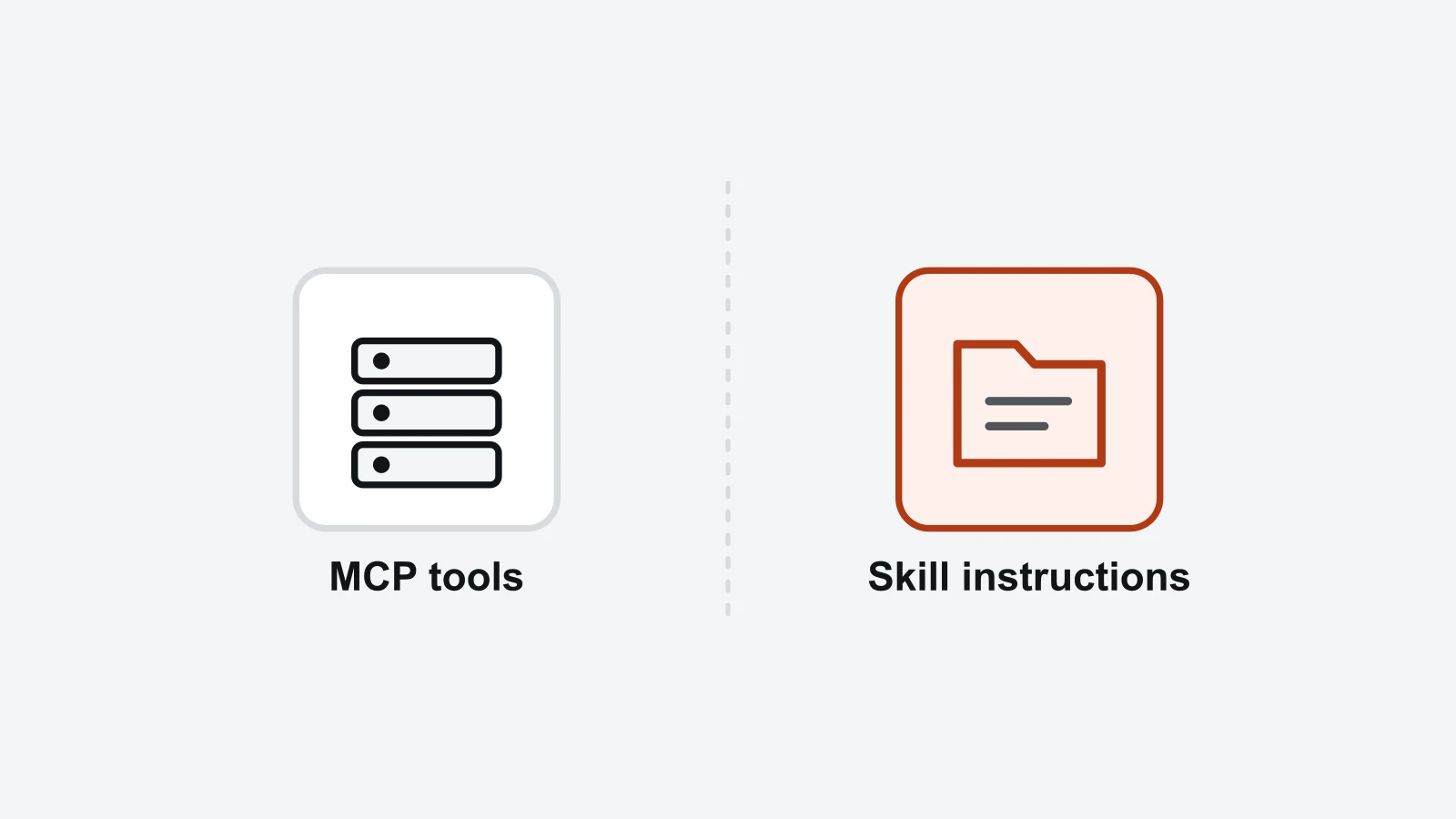
The key difference between MCP and skills is access against procedure. Both extend AI tools such as Claude, but they solve different problems. Anthropic puts it in one line: MCP connects Claude to data, and skills teach Claude what to do with that data.
- Skill
Explains how to perform a task.
- MCP server
Exposes connected tools or resources.
- Together
A skill can guide use of those tools.
Neither layer should imply unsupported account permissions.
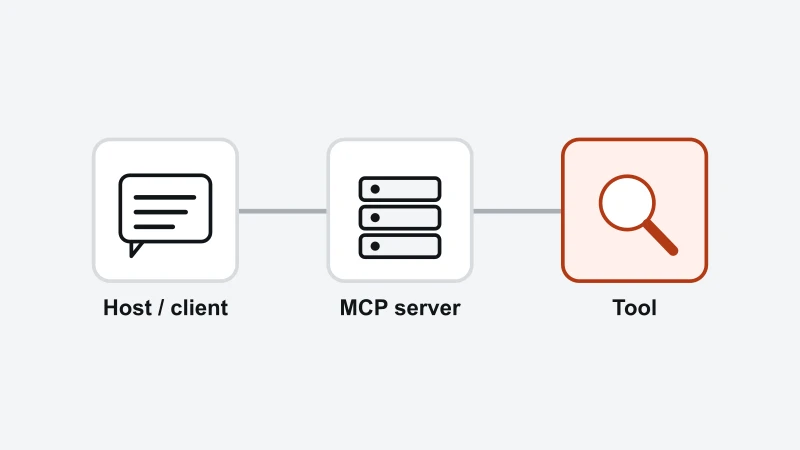
An MCP server is software that speaks the Model Context Protocol, an open spec, and exposes tools an assistant can call against a live system. Each MCP tool has a name, a description and a JSON input schema, and the server handles authentication and permission checks. How MCP works covers the machinery.
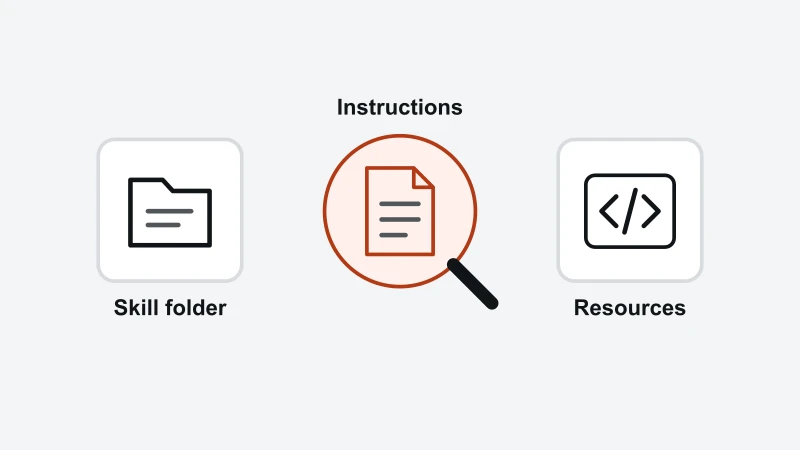
A skill is a folder with a SKILL.md file: YAML frontmatter, then instructions in natural language that the assistant loads when a job matches. Non-developers can write one, and it can bundle scripts to execute. What Claude Skills are covers that half.
Aspect | MCP server | Skill |
|---|---|---|
What it is | A running service that speaks the Model Context Protocol | A folder with a SKILL.md Markdown file |
What it gives the assistant | Access to external data and actions | Domain expertise and a repeatable method |
Written in | Code, usually wrapping an existing API | Natural language, optionally with scripts |
Loaded into context | Tool descriptions, once connected | About 100 tokens until a job matches, then the full instructions |
Security | Authentication such as OAuth, plus scoped permissions | None of its own; it can only use what the client already allows |
Typical failure without it | Generic advice where you wanted your own numbers | Right tools, used differently every time |
The two are fundamentally different layers. One is a capability and the other is a competence, which is why most real setups end up using both.
What does a Model Context Protocol server do?
MCP provides access: an MCP server turns an outside system and its data sources into tools an AI agent can call. It usually fronts APIs the vendor already runs, translating each API call into a tool with a clear description so an LLM can choose it unaided. Servers can also provide context through resources, documents an assistant can read.
MCP is also where the security boundary, auth included, lives. On the RankX AI MCP server, every tool declares the scope it needs, and a tool outside the connection's scopes is not even listed. A token can be issued for reading only, while the OAuth consent screen grants the full set in one decision and names each capability.
Tool descriptions and tool calls carry rules that the server enforces, not the model. Every RankX AI tool that spends credits states its current price in its own description, so the assistant knows the cost before it calls.
How do skills add domain expertise?
Skills provide domain expertise: a written method the assistant follows every time a task matches. Think of skills as runbooks the agent actually reads, kept as Markdown files that anyone on the team can edit.
Skills are reusable and cheap to carry. Anthropic's documentation puts each skill's metadata at about 100 tokens until a job matches, so many skills can sit installed without crowding the context window.
Skills shine where judgement and order matter, the parts LLMs otherwise improvise. Which tools to call, what to confirm before anything spends, and how to report a missing number are procedure, and procedure is what a skill holds.
When should you use MCP for external data?
Use MCP when the assistant cannot reach something it needs. Live rankings, tracked prompts, Search Console traffic and the CMS you publish to are external data on external services, and no instruction file can create access to them.
Sign | What it means |
|---|---|
The assistant gives generic advice instead of your figures | It has no data source to read |
It asks you to paste exports into the chat | The data lives behind a login it cannot use |
A change has to happen in a live system | An action needs a tool with a permission behind it |
The rule must hold even against a careless prompt | It belongs in the server, not in instructions |
Many MCP servers can sit in one client, and each adds its tool descriptions to every session. Connecting the RankX AI server is one URL in Claude, and the best MCP servers for SEO compares the options for search work.
From RankX AIChoose a procedure and connection for a defined task.A repeatable workflow can use both, but neither creates permission for a live edit.Review the agent-skills guideWhen should you use skills?
Use skills when the assistant has the tools and still does the job differently every time. Anthropic's rule of thumb is that if you keep typing the same instructions across conversations, those instructions belong in a skill.
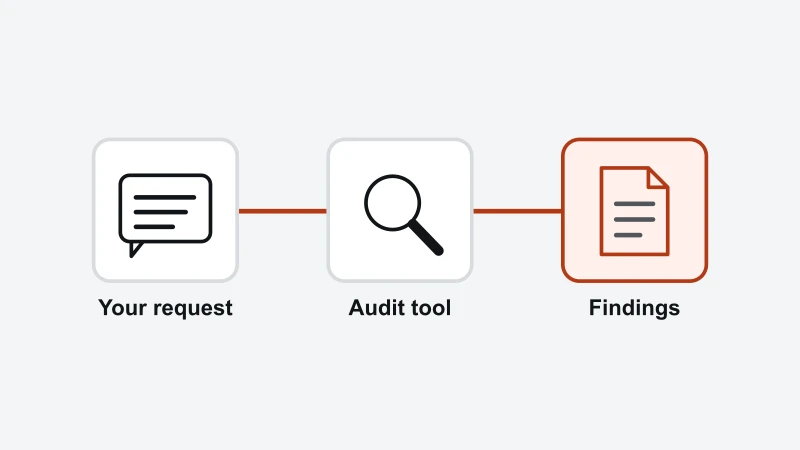
The RankX AI visibility audit is a working example. The tools to audit AI visibility all exist on the server, and an unaided assistant will use some of them, in some order, with some treatment of missing data.
The skill fixes all three: which tools, in which order, confirm before anything spends, and report an unmeasured assistant as no result yet rather than as zero. That last rule is what earns the file, because the gap between a right answer and a confident wrong one is often a denominator.
Running the audit end to end shows that procedure at work. To build skills of your own, how to write a Claude Skill covers the frontmatter and the description that decides whether a skill loads.
How do you decide between MCP and a skill?
Decide by naming what the use case is missing: access or method. The table maps the common symptoms to the fix.
- Needs a workflow
Consider reusable instructions.
- Needs live evidence
Consider an appropriate connected tool.
- Needs both
Combine the instruction and access layers.
Start with the missing capability rather than choosing a format first.
Symptom | Use | Why |
|---|---|---|
The assistant cannot see the data at all | MCP | No instruction substitutes for access |
It sees the data but improvises the method | A skill | Write the procedure once instead of re-prompting |
A limit must hold whatever the prompt says | The MCP server | Scopes and prices sit below the instruction layer |
The knowledge is yours: voice, thresholds, report format | Your own skill | A Markdown file you can write this afternoon |
A task needs its own context and restricted tools | A subagent | Anthropic recommends sub-agents for isolated execution |
Someone asks which one to adopt | Both, in that order | Connect first, then add the method |
Agentic tools like Claude Code read skills natively from a folder and connect MCP servers with one CLI command. That makes trying both a short job rather than a project.
How do MCP and skills work together?
MCP and skills work together by splitting the job: MCP handles connectivity, and skills handle sequencing, presentation and workflow logic. Anthropic's own example is Notion, where the MCP connection searches and creates pages and a meeting-prep skill says which pages to check and how to format the result.
Implementations today package them as one unit. Agent Skills became an open standard in December 2025, and Agent Plugins 1.0.0, published by Vercel on 6 August 2026 with maintainers from AWS, Cursor, Microsoft, OpenAI and Vercel, bundles skills and MCP servers into a single plugin.
RankX AI ships the same pairing: one MCP server and six skills written against its tools, documented in the Agent Skills reference and the tool reference. Both are part of the RankX AI web app for WooCommerce and other websites; the Shopify app works inside Shopify admin instead.
Decide what a product-copy workflow is missing
If the assistant cannot read the authorised product facts, the gap is access. A suitable connection or a permitted export may solve it.
If it can read the facts but changes tone, invents specifications or skips review steps, the gap is procedure. Clearer instructions and tests address that problem.
A repeatable workflow can use both, but neither creates permission for a live edit. Keep the original product fields, proposed changes and unresolved facts visible to a reviewer.
A small owner-led shop reviewing five products may need only an export and a written process. Add a live connection when the recurring task and supported operations justify it.
Questions about AI Agents and MCP
Is an MCP server a skill?
No. An MCP server is running software that holds credentials, exposes tools over the Model Context Protocol and enforces permissions. A skill is a document the model reads, with no runtime of its own, so the server changes what the assistant can reach and the skill changes how well it uses it.
Are skills replacing MCP?
No: a skill cannot authenticate, cannot enforce a permission and cannot fetch a number from a live system, so it cannot stand in for a server. Choosing skills over MCP stops being an option once the job needs live data. Vendors now ship skills written against their own MCP servers, and the Agent Plugins standard packages the two together.
Can I use skills without MCP?
Yes, when the job needs no outside system. A skill that teaches Claude your editorial voice, report format or QA checklist works on the conversation alone. Once the job needs live rankings, analytics or your CMS, a skill without a connection can only describe what it would have done.
Can I use MCP without skills?
Yes, and every connection starts that way. Each tool carries its own name, description and input schema, so an assistant can discover and call it unaided. What you lose is consistency: which tools to call, in what order and what to confirm first get decided again every session.
Do skills and MCP servers ship together?
Increasingly, as one package. Agent Plugins 1.0.0, published by Vercel in August 2026 with maintainers from AWS, Cursor, Microsoft, OpenAI and Vercel, puts Agent Skills and MCP servers in a single installable plugin. RankX AI ships the pair as one MCP server and six skills written against it.
Sources
- Anthropic, Claude Skills explained: skills, prompts, projects, subagents and MCP, 5 March 2026 (opens in a new tab) Checked 2026-10-29.
- Anthropic, Extending Claude's capabilities with skills and MCP servers, 19 December 2025 (opens in a new tab) Checked 2026-10-29.
- Claude Platform docs, Agent Skills overview (opens in a new tab) Checked 2026-10-29.
- Agent Skills open standard specification, agentskills.io (opens in a new tab) Checked 2026-10-29.
- Vercel, Introducing Agent Plugins 1.0.0, 6 August 2026 (opens in a new tab) Checked 2026-10-29.
Asif Syed is the founder and CEO of RankX AI, the AI search visibility platform. He builds the product and writes here about GEO, AI search measurement and WordPress.
CoversThis article covers the AI Agents and MCP topic, the AI Visibility feature and the AI Readiness Score tool.
Terms usedContext Window, RAG (Retrieval-Augmented Generation) and Grounding.
Read this page asMarkdown: /blog/mcp-vs-skills.md.
All articlesEverything RankX AI publishes is listed on the blog index.
Ask an assistantAsk ChatGPT (opens in a new tab), Ask Claude (opens in a new tab) or Ask Perplexity (opens in a new tab).
Preferred sourceIf Google is your front door, you can add RankX AI as a preferred source (opens in a new tab), which asks your own results to surface more of what we publish.